Kaung Myat’s beginner-level Burmese students sat silently as he ushered in class by playing a song in Burmese. Once the clock struck 10:25 a.m., Myat paused the song and welcomed the group. Each of the class’s students received an individualized greeting in Burmese, with students practicing how to say how they were and ask the same of their instructor.
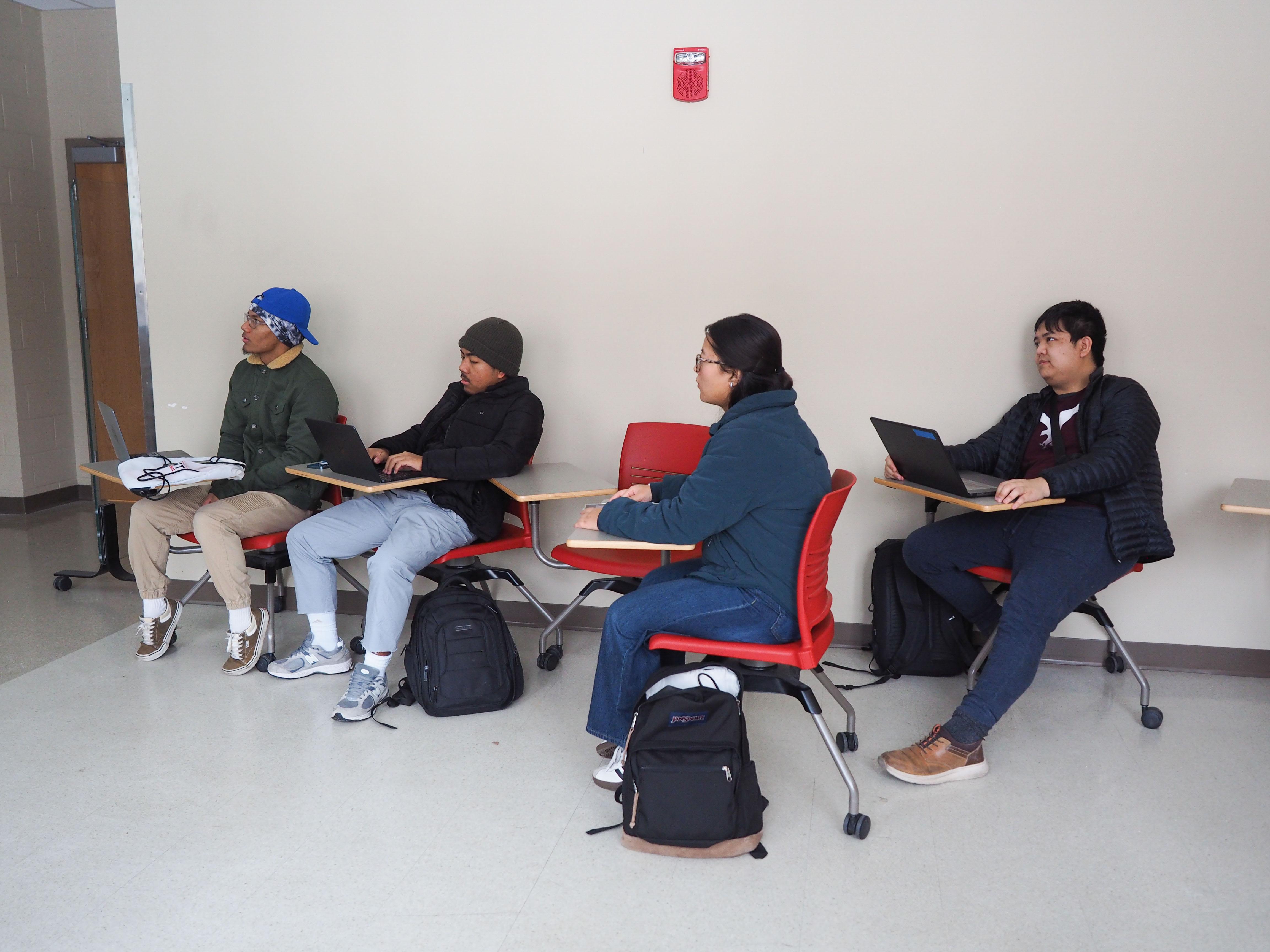
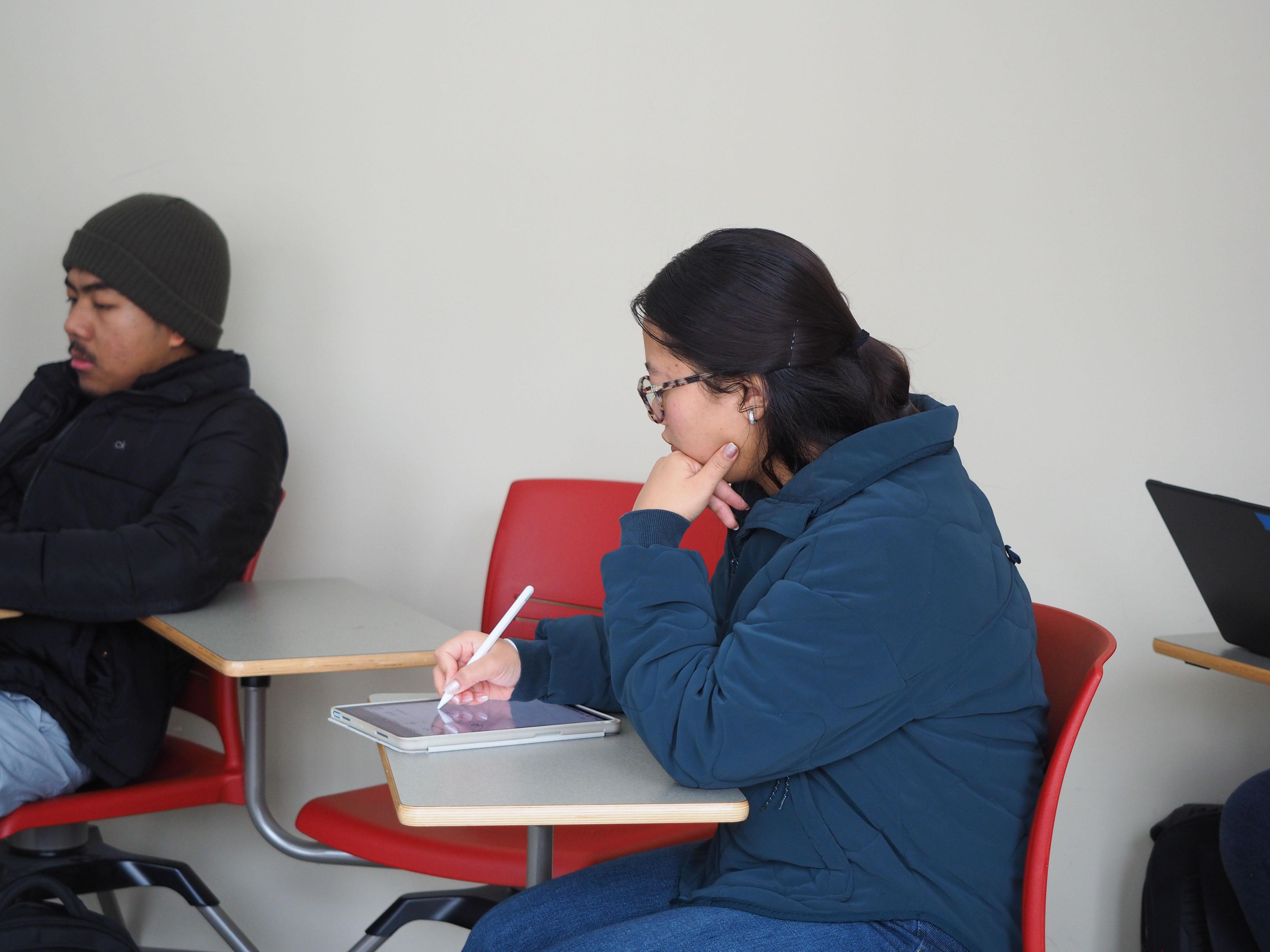
Myat, a doctoral student serving as IU’s sole Burmese language instructor, then began his lesson on vocabulary relating to health, sickness and body parts. He displayed a list of Burmese words for different body parts on the board, asking his students to guess their definitions.
Myat smiled at the students’ uncertainty.
“It doesn’t matter if it’s right or wrong,” he said.
Gradually, the translated list came together. Students repeated each term after Myat. They drilled the vocabulary again and again. Myat named a body part in Burmese and asked for the English term, then named a body part in English and requested the Burmese translation. On each drill, Myat asked his students to hasten their responses.
Learning Burmese holds an array of challenges for native English speakers. The language draws on an alphabet of 33 complex consonants and 12 vowels, many of which bear similar shapes. Although modern Burmese is generally written with spaces between clauses to ensure clarity, spaces are not required between words.
Written Burmese’s long strings of rounded letters are not the language’s only unfamiliar characteristic for English speakers. Burmese is a tonal language, meaning that a given syllable can hold three distinct meanings determined entirely by how it is pronounced. However, because of its limited number of distinct sounds, Burmese still features confusable homophones. The language is also monosyllabic, formed by attaching basic, one-syllable root words to one another to form more descriptive terms.
The constructive nature of Burmese vocabulary proved essential to this lesson. Myat used his instruction about parts of the body and previous lessons on core Burmese syllables to challenge the students to guess the terms for ailments. For instance, Myat tasked the students with deducing the term for “headache” now that they had learned the word for “head.” Having established a pattern, he asked the students to piece together translations for “toothache” and “stomachache.”
English and Burmese differ greatly in written and spoken structure. Still, Myat reached his students. Within minutes, the class added new vocabulary to their repertoire, and within a few minutes of drilling, the class could recall the terms instantly.
Breaking down barriers between English and Burmese is a familiar process for Myat, who has been a language instructor for 10 years. He became an English tutor in 2015 while a student at Myanmar’s Sagaing Institute of Education. At the university, he said, teaching opportunities were generally reserved for senior teachers pursuing professional development. Still, because professors recognized Myat’s talent for teaching English, he got his foot in the door.
Myat spent his college years in Myanmar researching universal principles of language instruction. He transitioned from teaching Burmese students English to teaching American students Burmese. Myat said coming to the United States and building an understanding of what strategies resonated most with students helped him improve at teaching.
“Teaching U.S. students makes me so excited,” Myat said.
Myat’s enthusiasm seemed to be shared by his class. As the students became familiar with their new vocabulary, hands shot up more quickly in response to questions. Increasingly confident voices competed to deliver answers. Having engaged his class, Myat smiled. Students weren’t just receiving instruction — they were learning.
•••
Myat was naturally curious about other cultures as a child in Myanmar, a country with vast ethnic and linguistic diversity.
“The friends I met in my childhood and teenage life came from different regions,” Myat said. “I went and visited their regions and noticed, ‘oh, their culture is not the same as my culture.’ It was interesting.”
Myat said this early interest in experiences different than his own sparked his desire to teach languages. Still, he encountered obstacles to his aspiration.
Because Myanmar is a former British colony, English is taught in all schools and at all levels of education. However, Myat said Myanmar’s curricula emphasize reading and writing over speaking and listening, resulting in relatively low communicative English proficiency. Myat also said classes he encountered typically had a minimum of about 75 students, overcrowded for individualized instruction.
Education in Myanmar crumbled in the decades following a 1962 coup that installed military rule. Hopes for reform were rekindled in 2010 when a civilian government transitioned to power. The new government freed political prisoners, instituted free and fair elections and tolerated privately-owned newspapers. It also undertook a comprehensive education reform plan designed to make the education system more effective and accessible.
When the military restored authoritarian, isolationist rule with a 2021 coup, education progress halted. Combined with the COVID-19 pandemic’s devastation in Myanmar, the new political order produced plummeting school enrollment and rising dropout rates.
“Education was not good, and I love freedom, traveling freely around the world,” Myat said.
Because of these values, Myat felt compelled to respond to the government upheaval. A university teacher at the time of the coup, Myat joined Myanmar’s 2021 Civil Disobedience Movement, a wave of public sector workers’ strikes, economic non-cooperation and protests resisting the junta.
While Myat protested, he also waited to hear the results of his application to be a 2021 Fulbright Foreign Language Teaching Assistant. He heard about the opportunity through a friend who previously won the award, using it to teach Burmese at IU. The program would allow Myat to feed his dual passions of teaching languages and world travel.
“When I heard about the program, I knew I was interested in it,” Myat said. “I heard I would be teaching as the main instructor if I applied to IU, so I would get lots of experience.”
The scholarship was a competitive opportunity. Myat said there were only four or five spots available for Burmese scholars to teach in the U.S., and IU’s offer of a head Burmese instructor position was particularly rare — but he made the cut. On Aug. 26, 2021, he left home for Indiana.
At the end of Myat’s one academic year of Fulbright backing, however, the political environment in Myanmar was as volatile as when he’d left. The military remained in power, employing widespread violence against civilians — particularly those who had engaged in anti-government protests.
“I didn’t know what to do, if I should return to my country or stay in the U.S.,” Myat said. “People who participated in the Civil Disobedience Movement, like me, got stopped trying to leave the country. Some had to pay lots of money; some got arrested.”
Concerned as a former CDM participant, Myat contacted the U.S. embassy in Myanmar, saying he would only return if his safety was guaranteed. When the embassy couldn’t make the assurance, Myat decided to stay in the U.S. He moved to Los Angeles for a gap year, working fast food jobs while living among the city’s thriving Burmese community.
While Myat was in Los Angeles, IU’s Southeast Asian Studies Department offered him an instructor position. He began teaching Burmese remotely to IU students. Invested in language education, he decided to pursue a doctorate.
Myat moved back to IU as an instructor in January 2024 and was admitted to the School of Education’s Literacy, Culture and Language Education program this past spring. He said he hopes the program will help him realize his dream of being a professor, whether in the U.S. or Myanmar.
“I want to do good for my country,” Myat said. “I would definitely go back if the situation got better.”
Myanmar has been embroiled in a bloody civil war for decades. A dizzying array of political factions are jockeying for power across the diverse nation, with civilians — and particularly minority groups — in the direct line of fire. Recent nominal elections have done little to persuade experts that democratization is coming any time soon.
In the meantime, Myat uses Burmese to stay connected to Myanmar. He said he uses voice recordings of people from home to demonstrate Burmese pronunciation to his students and integrates cultural context into his syllabus.
“My students learn about the culture, identity and history,” Myat said. “This goes way beyond proficiency.”
•••
Once Myat’s students began to master their new list of health and sickness vocabulary, it was time to apply what they’d learned. Myat projected basic conversation structures, like how to ask how someone was feeling or if they’d taken medicine, onto the board. He played voice recordings of the exchanges to familiarize the class with the sounds and inflections of the language. Then, it was time for the students to have conversations of their own.
Myat chose two students at a time to practice their vocabulary in context. Exchanges began tentatively, with students ironing out difficult pronunciations to ensure their syllables resonated accurately.
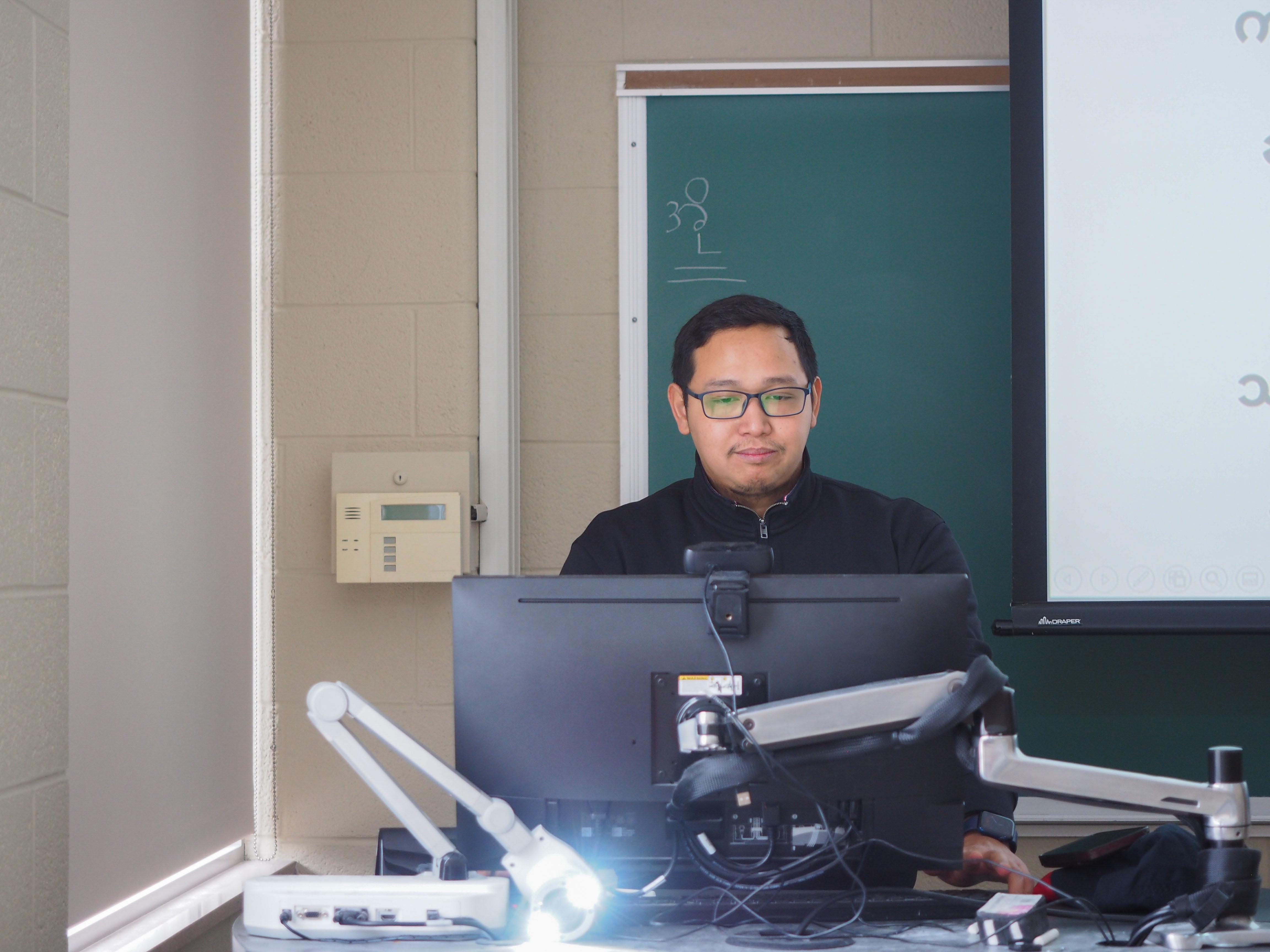
The classroom was dark, quiet and mostly empty. Because Myat administers his classes through a hybrid model, three of his eight students participated in person that day while their peers joined via Zoom. This divide only added to the students’ challenge of finding confidence and connection in a language they were still in the early stages of learning — and to Myat’s challenge of keeping them engaged.
Still, Myat’s smiling, yet firm encouragement continued to reach his class. He had the students employ the structures in different combinations, switching their roles between questioning and responding and instructing them to describe a variety of maladies. With each pass through a conversation, Myat pushed the students to respond more quickly, a signal of language assimilation.
As the students learned the conversation patterns, the voices echoing through the classroom became more fluid and self-assured. Students mouthed words back to themselves, silently reinforcing the sensation of speaking the language.
Eyes once buried in notebooks or fixed on the screen now found those of other students. Although the conversations unfolded in formulaic structures, they began to sound organic. Smiles crept onto students’ faces as they used one another as a learning resource.
In 50 minutes, the class had learned to converse with entirely new vocabulary. Myat congratulated his students on their progress as they filed out of the room and he closed the Zoom meeting.
•••
IU has long been renowned for offering courses in the most languages of any university in the U.S. However, these offerings have been under threat in recent months.
Because of an Indiana House bill that took effect in July, all IU bachelor’s degree programs must produce at least 15 annual graduates. In September, the U.S. Department of Education also cut funding for an array of university programs that “do not advance American interests or values.”
The result? The culling and reworking of over 400 IU degree programs, with the language department taking an outsized hit.
Burmese-language education is particularly relevant in Indiana, which has been the top relocation site of Burmese refugees to the U.S. for about 40 years. Today, Indiana is home to about 12% of the country’s Burmese population, the largest community of any state.
Many of Myat’s students are heritage learners — children of Burmese parents with some limited exposure to the language. However, his classes have diversified in his time teaching at IU. Myat said his students now hail from a range of ethnic backgrounds, unified by a curiosity to explore Burmese culture.
Myat said learning to forge connections through language study has practical uses.
“I asked a student why she wanted to learn Burmese, and she responded that in her workplace, she’s surrounded by Burmese people,” Myat said. “She wanted to communicate with them and to learn about their culture. This opens opportunities.”
Myat said the practicality of language education isn’t limited to professional development, though — and that learning languages might just serve U.S. interests, after all.
“In a country like the U.S., we have to find unity in our diversity, to live in harmony,” Myat said. “This is a way to build friendships and understand each other.”
Like what you're reading?
Support independent, award-winning student journalism.
Donate.