Trailblazers. That’s what announcers at Bill Armstrong Stadium in Bloomington called members of the 1973-76 Indiana men’s soccer teams as they walked across the field Oct. 2.
It was halftime. The 2026 squad had a 2-0 advantage over Maryland in the first 45 minutes. But some of the loudest cheers during the game went to these foundational players of the program.
Emerging from the Jerry F. Tardy Center on the opposite side of the home stands, 19 members of those Indiana men’s soccer teams, wearing red hats and black scarves, lined up at midfield.
Eight stars for each championship title adorned each hat. Yet when those players wore Cream and Crimson in Bloomington, the Hoosiers weren’t a household name and had zero titles.
“I said, ‘Give them something to be really proud about,’” current Indiana head coach Todd Yeagley said pregame. “This group, there's a lot of responsibility when you wear the jersey. But tonight, in particular, with those alums here that put us there, give them something to smile about tonight.”
Indiana's victory gave its alumni something to smile about, just as the 1976 team had 50 years before.
•••
After graduating from the University of Pittsburgh, Jerry Yeagley moved 400 miles west to become the Indiana men's soccer head coach in 1963. The club soccer program had been around since 1947, but Yeagley — father of current Indiana coach Todd Yeagley — wanted to transform the team into a varsity sport.
Throughout his decade as club soccer head coach, Yeagley treated his players as varsity athletes. Though the school wouldn’t fund the program, Yeagley used his own teaching salary for expenses.
The program sought varsity status throughout the late 1960s and into the 1970s, but IU officials repeatedly turned them away.
Indiana finished the 1972 season 12-0 and was selected for the NCAA Tournament — even as a club team — but the university administration denied the Hoosiers' request to travel to Miami.
By 1973, pushes by former club players and the student body president swayed the administration to finally grant them varsity status.
“In '73, we promised the athletic director we would not take any scholarships,” former Indiana club player Gary Fresen said. “And that we'd run the program as we always did, on $8,000.”
Indiana produced on the field despite the shoestring budget. The Hoosiers earned double-digit wins from 1973-75, made an NCAA Tournament appearance in 1974 and continued building a talented roster under Yeagley.
Throughout his head coaching tenure at Indiana, Yeagley quizzed his players: Are you a piano player or a piano carrier?
“You need both kinds,” former player Dave Shelton said. “The players are the fancy guys, and the carriers are the hard-nosed guys.”
The 1976 Hoosiers had both.
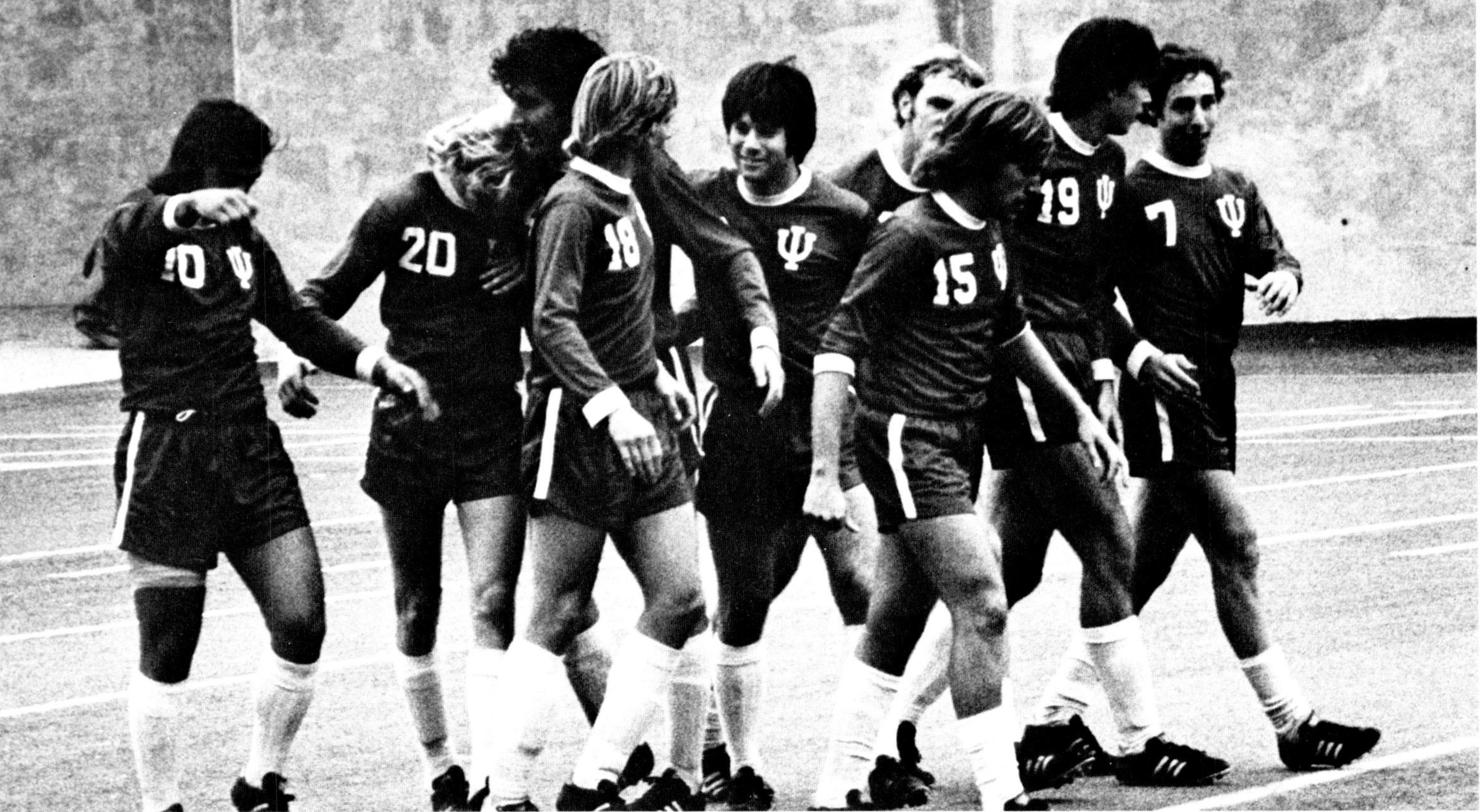
Arbutus File Photo
The 1975 Indiana men's soccer team, which posted a winning record but failed to make the NCAA Tournament, is pictured. Saint Louis University defeated the Hoosiers 4-1 in 1975.•••
George Perry grew up playing soccer in men’s leagues around the Chicago area for a historically Ukrainian team. Perry first played a season with the University of Alabama in Huntsville but didn’t enjoy its rigid system. After entering the NCAA transfer portal, he traveled back to Chicago.
“I spoke with Cary Feld, who had come in as a freshman in '74,” Perry said. “He encouraged me to look at IU and stuff like that, and I did. I had a visit, met Coach Yeagley and that was it.”
Transfer portal regulations were different then, meaning Perry had to sit out the 1974 season. Still trying to gain game experience, Perry hitchhiked from Bloomington to Chicago for weekend games before flying back on Sundays.
Perry’s time with his teammates was limited to Sunday practice sessions and a winter indoor league in the HPER Gym, now known as the Bill Garrett Fieldhouse.
Perry’s determination, despite not playing, led Yeagley to name him a team captain before the 1975 season, a designation he carried into the 1976 campaign.
In Indiana’s backline, Perry was joined by Joe Andert, Jim Mercurio and Mike Freitag, along with Feld as goalkeeper.
“Indiana was definitely known for our defense,” Perry said. “We take a lot of pride in the way that we defend individually and collectively. Coach spent countless hours on us doing the same thing over and over again.”
The defenders helped the Hoosiers compile 11 clean sheets throughout the 20-match season.
And in its first five games of the 1976 season, the Hoosiers didn’t give up a single goal.
It wasn’t until October that the Hoosiers ceded a score. Then, a second. The University of Akron presented Indiana with its first challenge.
Yet the Hoosiers scored two goals to match Akron’s before the final whistle of regulation. With four minutes to go in the second and final overtime period, Perry’s co-captain — senior Rick Spray — passed to freshman Mark Simanton for the game-winning goal.
Indiana couldn’t celebrate its game-winner for too long. The Hoosiers still had to face off against their toughest competition of the season: Saint Louis University.
•••
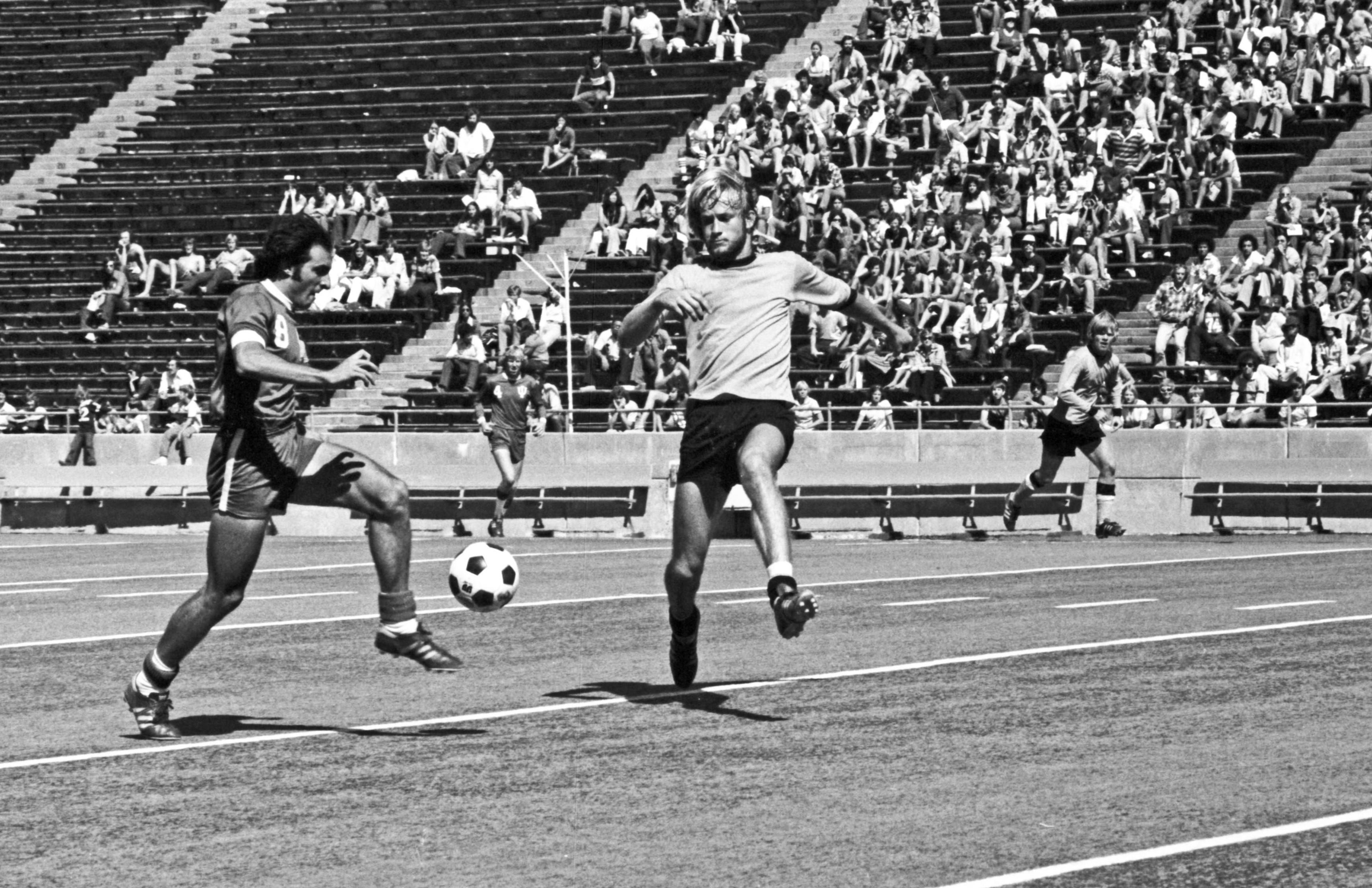
IU Archives
Angelo DiBernardo (left) plays during an Indiana men's soccer match in 1976. DiBernardo played three seasons with the Hoosiers from 1976 to 1978.Angelo DiBernardo moved to Chicago from Argentina when he was 16. While working at a television factory, DiBernardo played for Chicago Sparta — a historic soccer club founded in 1917.
There, DiBernardo’s goal-scoring abilities caught Yeagley’s eye.
“Coach Yeagley recruited me to go to Indiana through a teammate of mine, Charlie Fajkus,” DiBernardo said. “I think his father, who was my club coach, was very instrumental in informing coach Yeagley that he knew someone that might be interested in going to Indiana.”
Throughout his freshman season, DiBernardo scored 20 goals and assisted five others. He knew about the Hoosiers' rivalry with Saint Louis.
The Billikens were the most successful, dominant and revered program at the time, winning 10 of 17 national championships by the 1976 season, appearing in three others.
Saint Louis had also humbled the Hoosiers in 1975. With Yeagley priding himself on the defensive end, the Saint Louis offense walloped the Hoosiers for 90 minutes in a 4-1 victory— the first time Indiana gave up more than two goals in a varsity match.
By Oct. 10, 1976, the Hoosiers were ready for the Billikens.
Before the season, Indiana had defeated Saint Louis 3-1 in an exhibition match. However, without it counting toward either team’s season records, the Billikens came into the matchup as the No. 2 team in the country.
The Hoosiers’ 5-0-1 record helped them carry momentum into the matchup.
DiBernardo scored three goals in the first half and helped the Hoosiers control ball possession. Indiana created chances on the counterattack, and DiBernardo added two additional goals in the second half. His five goals gave Indiana a 5-1 victory, its most consequential of the season.
"We were not lacking any confidence. We knew that we could play with anybody,” DiBernardo said. “We were very confident as individuals and as a group right off the gates. It's just that we needed to convince people.”
And the collegiate soccer world was convinced.
•••
Most of the players Yeagley added to his team were from two soccer hotbeds in the Midwest: Chicago and St. Louis.
“St. Louis kids were more the defenders and midfielders,” Freitag said. “And the Chicago kids ... were more attacking-minded and more creative. And the combination of the two, Jerry looked like a genius.”
One such combination came in the midfield with Dave Shelton and Rick Spray, along with freshman Charlie Fajkus. Coming from Chicago, Shelton was a well-known high school recruit and attacking option for Indiana who played for a Ukrainian neighborhood soccer club, while Spray helped attend to the Hoosiers’ defensive pursuits.
When the men’s soccer team transitioned from club to varsity, Yeagley initially accepted the condition that no scholarships would be given to players. But by 1974, Shelton and three others received scholarships to help recruiting efforts.
Though he only scored three goals during the 1976 season, Shelton became a key cog in Yeagley’s system. The junior’s expertise helped transition the team from defensive stops to offensive attacks.
Indiana kept rolling as the season progressed and finished the regular season 15-0-1, earning the No. 1 seed in the Midwest region of the NCAA Tournament.
The Cream and Crimson then took down Akron in a rematch of the regular-season game and Southern Illinois University Edwardsville in an icy game inside Memorial Stadium to close November.
“We never played on ice because we never played that late before, and it had snowed,” Shelton said. “It was colder now. I remember that well. I think I wore gloves, but we wore shorts, and it was cold. I mean, bitter cold.”
Yet a 1-0 final score propelled the Hoosiers to their first College Cup in program history. As Indiana traveled to Philadelphia, some of the nation’s best awaited the Hoosiers.
•••
No. 3 Hartwick College was Indiana’s first competitor in the College Cup.
However, a pulled groin DiBernardo developed a few weeks before the tournament threatened Indiana’s “Cinderella” story. It got worse depending on the day, the weather and the game. He wouldn’t start against Hartwick.
The Hoosiers produced only three shots in the first 45 minutes. Shelton stepped up in his teammate’s absence, controlling possession in the midfield and defending Hartwick attacks, but Indiana couldn’t get on the scoreboard.
Enter DiBernardo.
“Coach Yeagley says, ‘If you're ready to go, let's go.’ And it just happened."
— Angelo DiBernardo
Coming off the bench at halftime, it took just eight minutes for DiBernardo to put the Hoosiers on the scoreboard. Tim Walters’ pass found DiBernardo, who ran by two Hartwick defenders before knocking the ball into the right-hand corner of the net.
But Hartwick wasn’t finished yet. Just 92 seconds after DiBernardo’s goal, the opponent got a shot past Feld’s fingertips.
Now, in a 1-1 scoreline, Indiana had to dig in.
Only 56 seconds after the game-tying goal, DiBernardo received a pass from Spray, barely maneuvered around two defenders and struck the ball past the Hartwick goalkeeper.
Indiana 2. Hartwick 1.
With under 19 minutes left, Indiana had to fend off any attack. Freitag provided two crucial clearances after Feld was drawn from the net. Hartwick outshot Indiana 11-5 throughout the game, but the Hoosiers held on.
For the first time, they were heading to the national championship.
•••
DiBernardo’s Sparta teammate Charlie Fajkus headed the three-man midfield with Spray and Shelton. Fajkus was named a high school All-American in his junior and senior seasons.
With schools from across the nation trying to recruit Fajkus, Coach Yeagley turned to Indiana’s other dominant sport for help: the Bob Knight-coached, nationally renowned men’s basketball.
“When I went on my recruiting trip to IU for a weekend, I mean, it was great,” Fajkus said. “Got to go to a basketball game and got to meet some of the players. So, that probably was the biggest determining factor in why I chose Indiana.”
By December 1976, Fajkus dominated opposing defenders and controlled the game for the Hoosiers. That season, Fajkus contributed nine goals and nine assists and was perfect on penalty kick opportunities.
The University of San Francisco greeted Fajkus and the Hoosiers when they stepped onto Franklin Field in Philadelphia for the national championship game.
The Dons won the 1975 national championship and returned nine of their starters, including star forward Andy Atuegbu. After the opening whistle, Indiana had to stop him to win its first national championship in program history.
In the 36th minute, Atuegbu made a move past the Hoosiers’ backline and unleashed a shot from 18 yards away into the back of the net.
“I gave one of those little turns,” Freitag said. “I kind of turned, and he hit a bomb that went into the corner. And to this day, I wish I would have made myself bigger because maybe the ball would have hit me.”
But the Hoosiers didn't let the lead become insurmountable. They attacked San Francisco’s backline and created a chance with two minutes remaining until halftime. Freshman forward Rudy Glenn made a move down the left side but was tripped in front of the goal.
Indiana was awarded a penalty. Fajkus, whose 12-yard kick was nearly automatic, walked up to the penalty spot. The midfielder usually went to the low-left corner of the net but decided to switch it up for the national championship match.
When Fajkus struck the penalty, San Francisco’s goalkeeper moved toward the usual side. It was a chance Indiana needed against the Dons. A shot that would’ve leveled the score.
Instead, the ball caromed off the crossbar and out of play.
“It's still something that haunts me to this day,”
— Charlie Fajkus
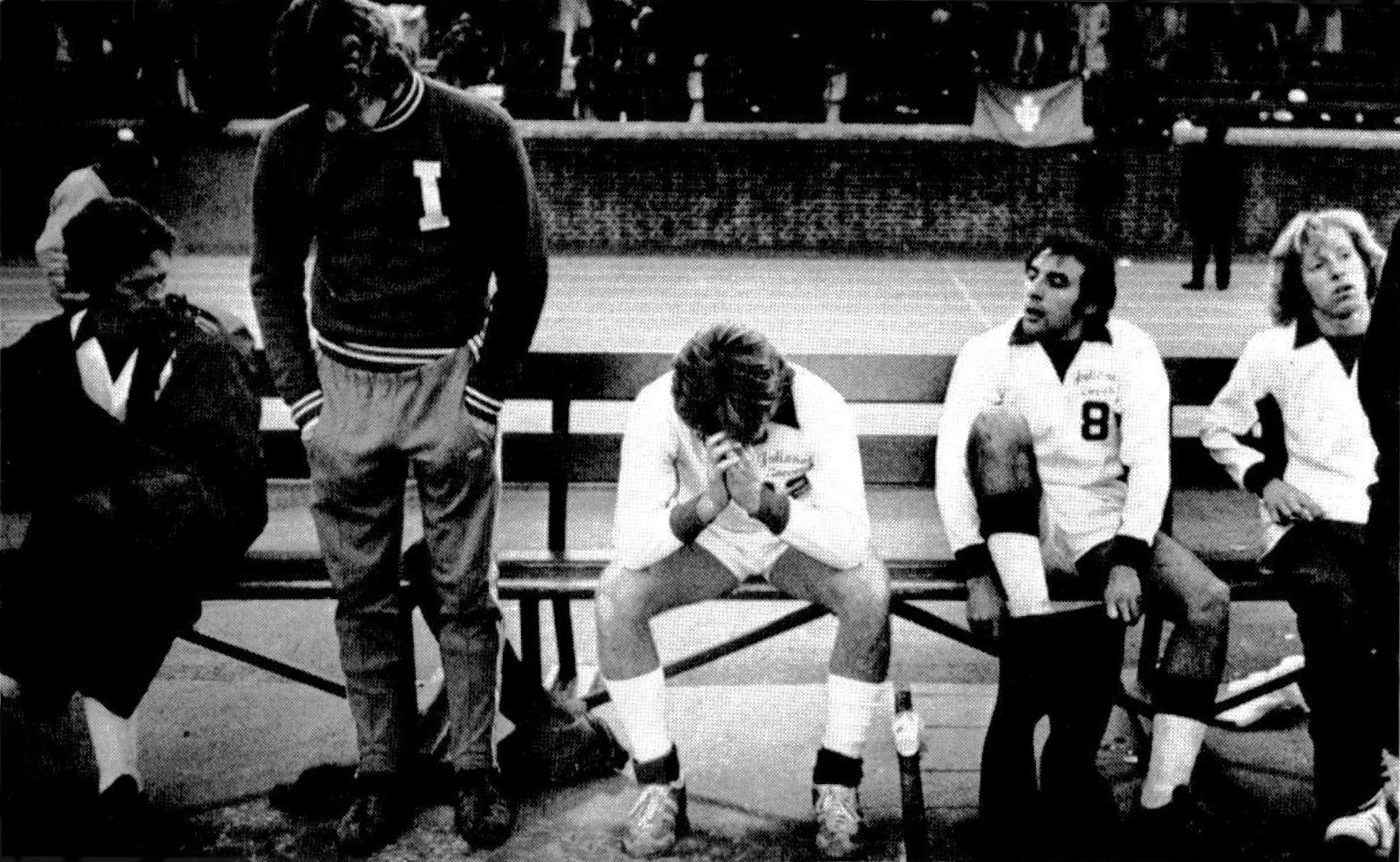
Arbutus File Photo
Then-Indiana men's soccer players Hudson Fortune, John Putna, Tim Walters, Angelo DiBernardo and Charlie Fajkus sit on a bench Dec. 5, 1976, after the national championship game against the University of San Francisco in Philadelphia. Fajkus missed a penalty during the game that would have tied the score.Indiana had more chances on goal throughout the second half, but none as good as Fajkus’ penalty. When the final whistle blew, all that mattered was the 1-0 loss on the scoreboard and a missed chance at the title.
•••
Indiana men’s soccer would go on to make national championship appearances in 1978 and 1980 before winning its first ring in 1982. After finally breaking through, the Hoosiers became a nationally recognizable brand in collegiate men’s soccer.
When Jerry Yeagley retired in 2003, the Hoosiers had won six national championships, including one in his final season.
“Coach has done so much for me as a player,” Freitag said. “At IU, you take all different courses. I took ‘Yeagley 101,' in my opinion. I studied him for four years.”
Yeagley turned the program over to Freitag, who won another national championship in 2004, before Yeagley’s son, Todd, took the reins in 2010. Indiana’s most recent title came in 2012.
DiBernardo went on to become Indiana’s first two-time All-American, winning the honor in 1977 and 1978. He also became the Hoosiers’ first Hermann Trophy winner in 1978. After finishing his career in Bloomington, DiBernardo wound up in the NASL’s New York Cosmos, playing with legendary soccer star Pelé.
“Those years that I spent at IU were unforgettable,” DiBernardo said. “The teams that I had the opportunity to play with, I always keep them in my mind. They don't go away.”
Those memories haven’t been forgotten by Indiana fans. As the 19 former players walked off Jerry Yeagley Field — named after the coach in 2004 — this October, fans stood and applauded the group. Though the 1976 Indiana men’s soccer team didn’t win a national championship, it laid a foundation for the program that still holds 50 years later.
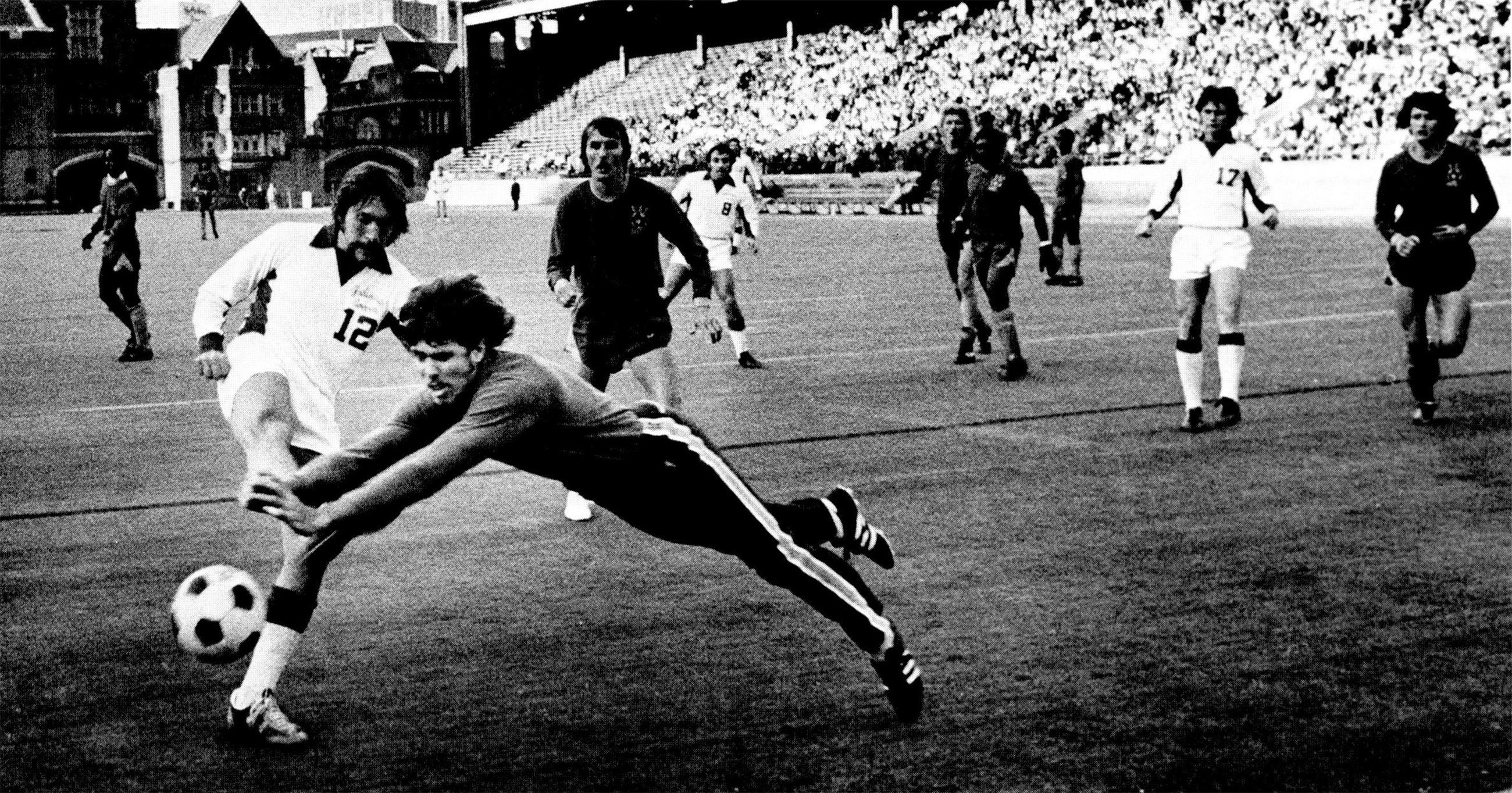
IU Archives
Indiana men's soccer players look on as the University of San Francisco goalie deflects an almost point-blank shot late in the game on Dec. 5, 1976, at Franklin Field in Philadelphia. The 1976 game ended 1-0, with USF taking the national title.
Like what you're reading?
Support independent, award-winning student journalism.
Donate.