As dawn breaks over the tailgate fields the morning after an Indiana University football game, the boys of the Edgewood High School football team pull on latex gloves.
They’re here to clean.
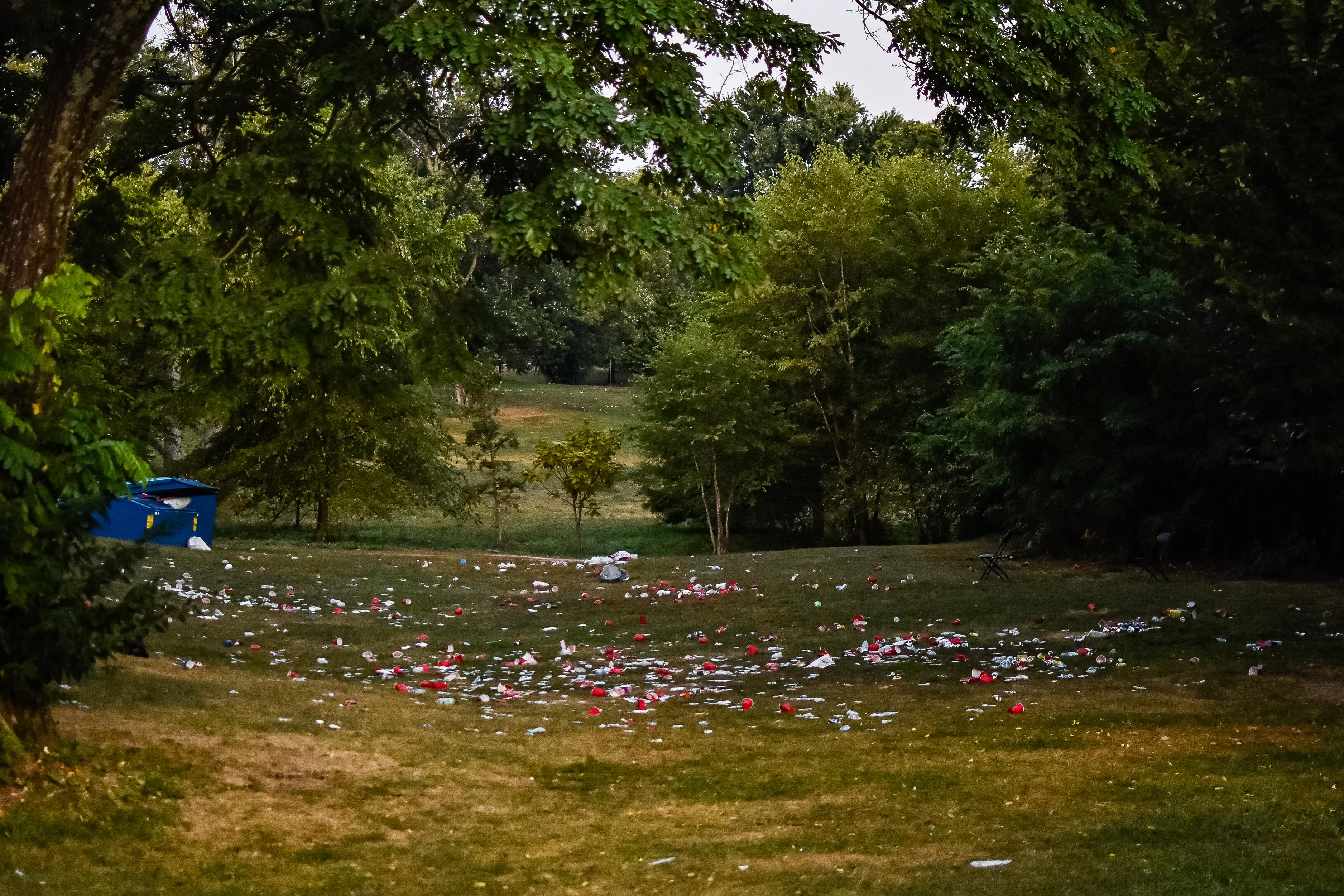
They’ll wade through a sea of aluminum cans and cracked red Solo cups, picking up the refuse and searching for ping pong balls and other keepsakes. They’ll step in and dump out gag-worthy substances. Before most tailgaters wake up hungover from the revelry of the night before, the fields will be clean.
They’re asked to arrive at 6:45 a.m., but the first of them trickle in around 6:20. Over-achieving morning joggers are their only witnesses. The two towers of Briscoe Quadrangle stand totally dark in the distance.
The underclassmen are subjected to showing up on the schedule of early-rising parents or older teammates willing to lend a ride. Boys with their own cars cruise into the dimly lit parking lot, its empty spots hazy and reflecting the yellow glow of Memorial Stadium’s lights. Headlights pierce the fog where boys wait in their cars, half asleep, trying to stay warm.
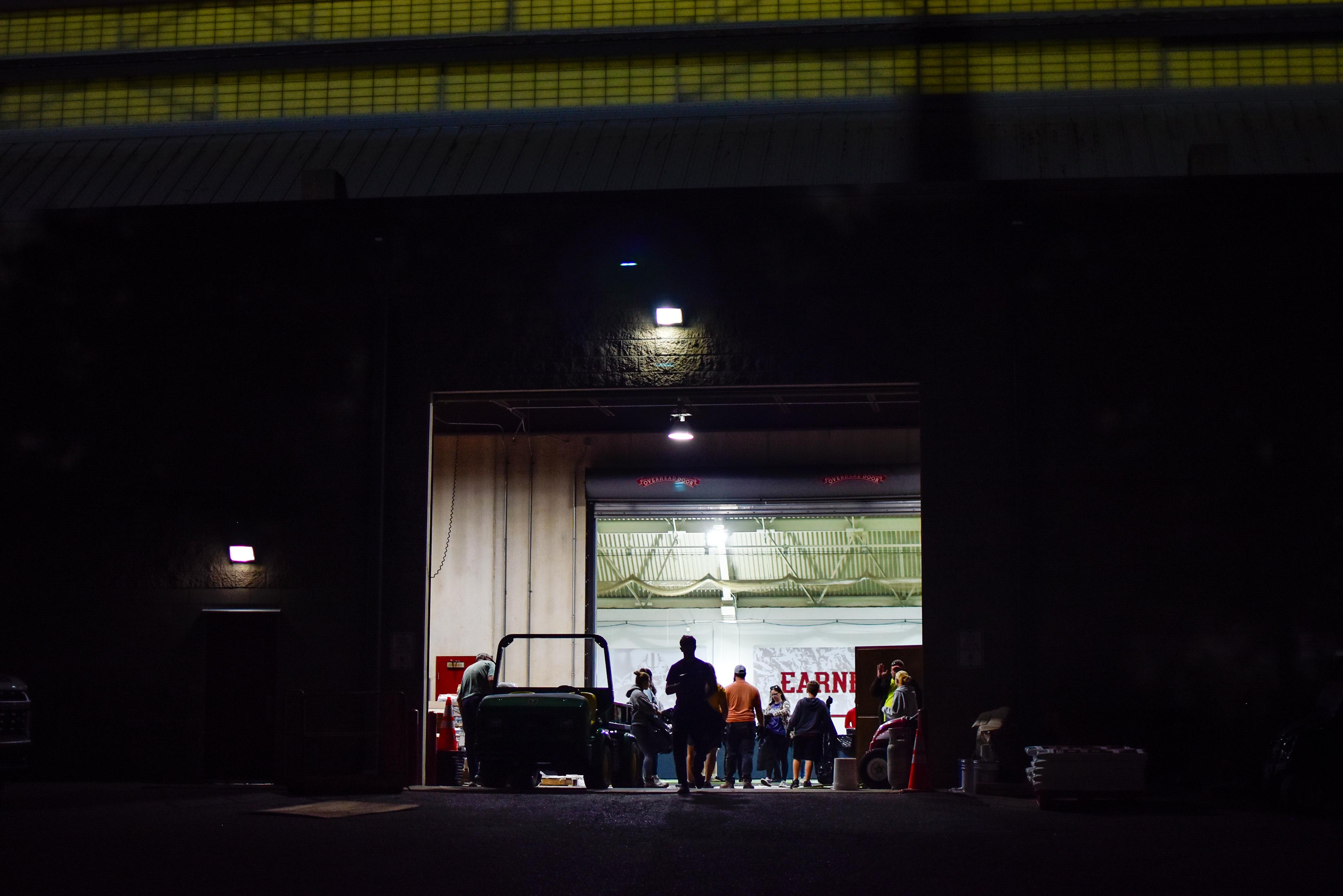
They journey out into the cold the October morning after IU’s homecoming game toward the garage storing their tools for the day. Daybreak illuminates the fleet of John Deeres and golf carts waiting to be fired up to collect the remains from the night before.
The boys reach for two pairs of gloves in tall cardboard boxes. One pair is latex to put on top, the other rough white cloth to keep their hands warm. Large rolls of black trash bags dwindle as they’re dispersed among the boys. One player stuffs an extra roll into his drawstring Adidas bag; he’ll pass them out once the first round of bags is full.
Breath fogs the frigid air the same way it does on game nights for the Edgewood team, but unlike the roar of a Friday crowd, all glory is gone in the stillness of the morning. Here, it’s quiet except for the sound of the boys’ groggy early morning chatter and the hollow rattle of beer cans rolling across the asphalt, propelled by the biting wind.
Edgewood coach Scott Fischer pops open the back of his black Chevrolet Silverado and sets out the boys’ breakfast. The hungry high schoolers attack chocolate milk in Dixie cups and five boxes of glazed Square Donuts.
Fischer shouts directions, arranges groups and silences complaints.
With empty trash bags billowing behind them, the team sets off into the dark as garbage collectors and treasure hunters.
•••
Growing up, Scott Fischer wanted to be the trashman.
Not the garbage truck driver, but the guy on the back of the trash truck. The one picking it all up.
On Tuesday mornings in Indianapolis, a young Fischer would watch the man he wanted to be, always tanned and shirtless, hanging off the back of the truck until puttering to a stop in front of a house. He would grab two trash bags, full of a week’s worth of waste, and sling them in the hopper before jumping back onto the truck to get rolling again. The man had a rhythm to his work, solidified by repetition.
“I thought he was the coolest guy in the world,” Fischer said.
Forty-five years later, Fischer’s living out his trash man dream. In the process, he’s also wrangling a high school football team. Reality is less rosy than his memory.

To Fischer, football is education. Not as a teacher of words or numbers, but of life.
When Fischer was hired at Edgewood, the athletic director asked the football team to take over tailgate cleanup from the softball team due to higher numbers in the football program.
Senior wide receiver Jaxton Collier was a sophomore when the tradition started.
“Everyone was really, really not happy,” Collier said. “It was like, why in the world would we go pick up trash at IU football?”
After playing for Fischer for three years, Collier understands exactly why the team does it.
“His big motto is teaching us how to be men in the real world,” Collier said. “He’s trying to get us to understand we don't just get everything for free.”
To Collier, the responsibility is worth setting five alarms and sacrificing some of his Sunday mornings.
“It opens their eyes a little bit to the world,” Josh Collier, Jaxton’s dad, said. “It makes them realize that they do have to do things even when they don't want to.”
Beyond the $1,500 the program earns from IU Athletics each shift, Fischer said it's an opportunity for the team to do something that’s bigger than themselves.
He doesn’t see the cleaning as giving back, but rather, as a chance to teach.
The cleanup is only one part of Fischer’s football as education philosophy; the bulk of that work happens on the field at Edgewood High School.
Practice starts at 3:30 p.m. There’s no walking at the Mustang Corral, not even for Fischer. When the team runs from drill to drill, so does its coach. Fischer’s voice echoes across the Edgewood stadium the same way it does Sunday mornings, clear and booming.
Fischer’s wife, Shontel, can see her husband’s brain churning when he gets home from work.
“Okay, what happened?” she’ll ask.
He’ll fill her in on what’s on his mind: plans for how to help hurt players, the ups and downs of practice and what the boys did that day.
“He takes all that so seriously,” Shontel said. "His brain never stops with football.”
Building these boys’ character through coaching, Shontel said, is just who Scott is.
•••
Sunday mornings begin and end as a disgusting Easter egg hunt.
Fallen leaves and overgrown brush camouflage every brand of smashed beer can. Red Solo cups rest in low-hanging tree branches.
The smell of stale beer lingers, seeping out from the dewy grass of the fields. It’s particularly suffocating near the overflowing trash cans. Food from the night before lays soggy and smashed.
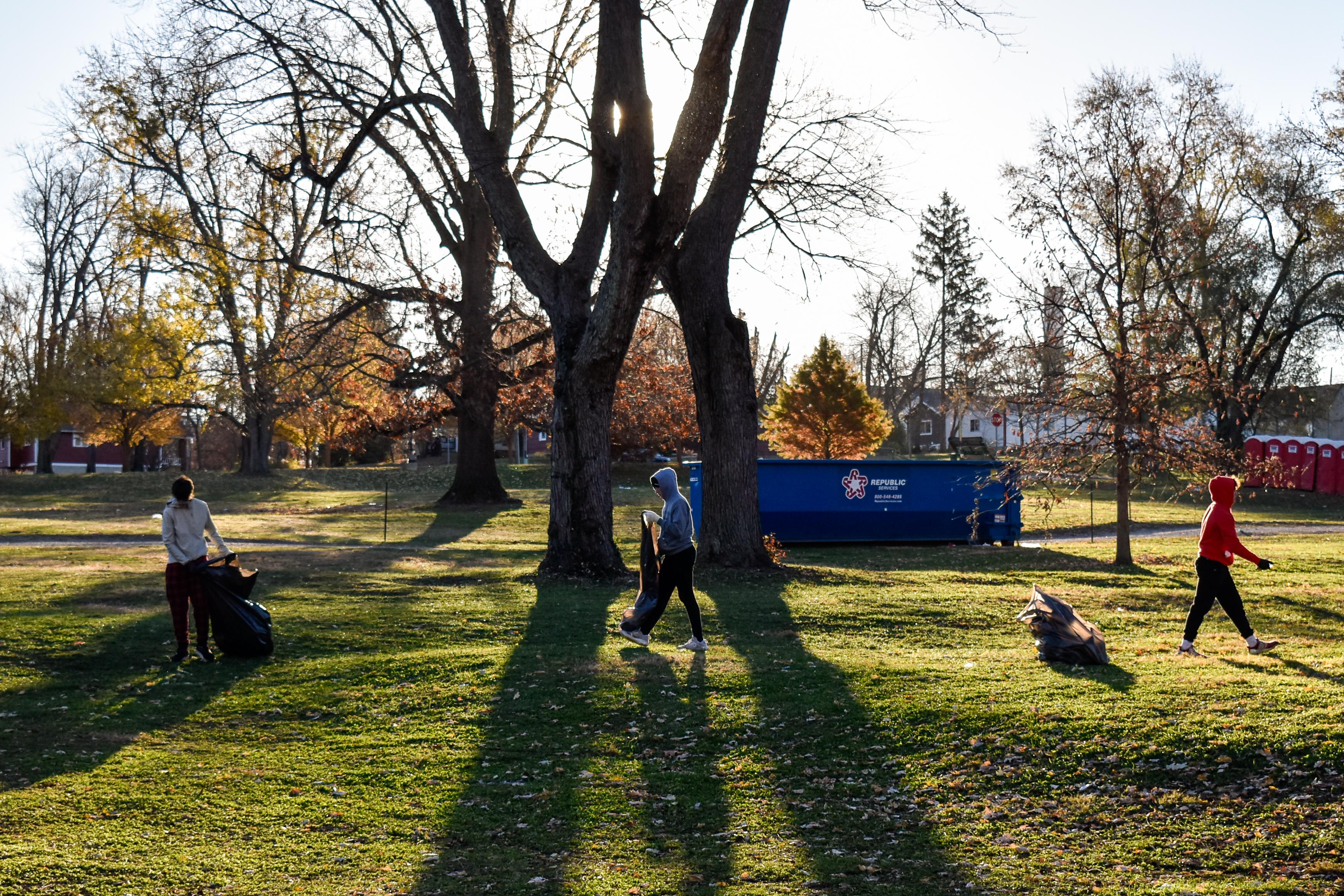
The boys pick up about half the trash on the first pass of a field. They keep themselves entertained in the dragging hours of the morning.
“Wanna see a kaboom?”
A player shakes a beer can and throws it full force into a nearby tree trunk, exploding on impact.
Buckets are never a good sign. The boys have seen 5-gallon plastic pails filled with human feces, puke and other unidentifiable substances.
“Like something you’d see like a third grader get up and throw up all over the classroom,” Collier said.
Sometimes the boys leave the buckets untouched, the stained containers too repulsive to handle even with two layers of gloves. Other times, an iron-willed player dumps the bodily waste onto the frozen grass.
One boy sings “Red Solo Cup” by Toby Keith as he pours an unidentified liquid from the cracked party cup. The boys classify the liquid in two plastic gallon milk jugs as urine.
Despite their unappetizing surroundings, food is always on their minds.
“If it’s unopened, it’s free game,” a player said.
The boys found a half-full box of Dunkin’ donuts in a pile of forgotten food. After checking for insects, a player ate two.
“There’s biscuits and gravy over here,” Fischer calls to a boy craving breakfast.
“Gravy?”
The player's head pops up from across the field, a huge smile spreading across his face as he walks over, trash bag dragging behind him. Blades of grass and dirt are smashed into the run-over biscuits and gravy, creating a mushed soup. The boy helps Fischer stuff it in an open bag.
In a pile nearby, a boy unveils a dish of molded Italian beef. He turns the other way to gag.
One player makes the mistake of vocalizing his hunger, so another throws a rock-solid bagel at him.
They fill their sweatshirt pockets with various knickknacks: a Gatorade water bottle, rally towels that one player keeps for Christmas presents and ping pong balls to bring back to the locker room table tennis table.
Sometimes they do find real treasures, like lost cash or jewelry — a wedding ring, once. A 55-inch TV that was left in the field now resides in an assistant coach’s man cave.
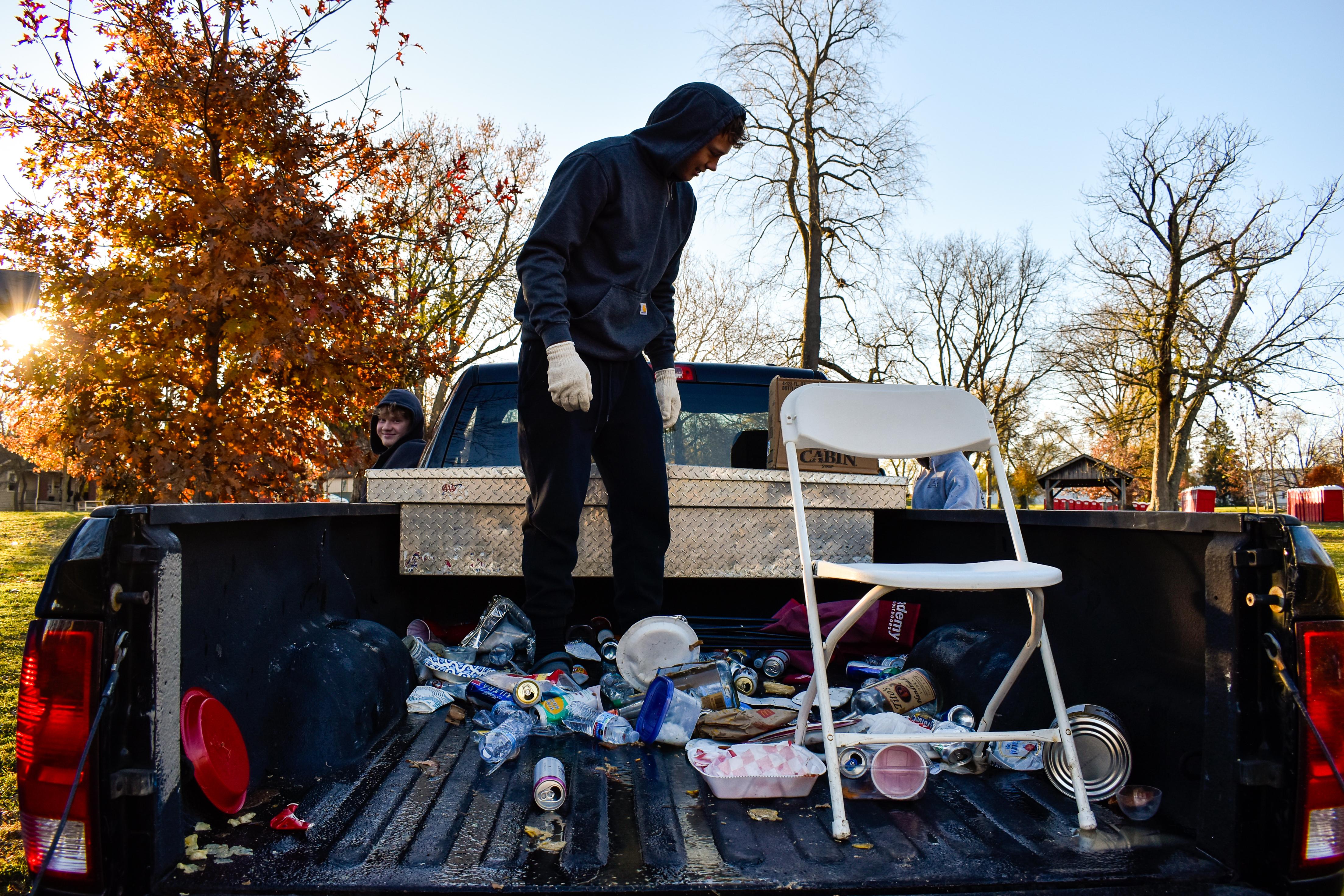
Often, the cleaning turns into a makeshift basketball game, the players trying to sink cans and old sandwiches into the black depths of their teammates’ bags.
Sometimes, beer cans become footballs when they run plays in the open field. They yell “Grenade incoming” before the beers hit the ground, exploding back into the air.
Coach Fischer and senior leaders try to get the team to stay in one line. Ideally, if they walk side by side and pick up every piece of trash in their path, fields can be cleared in the first pass.
Very rarely do they reach this level of efficiency.
“Oldest trick in the book,” a boy said, smiling to another player, “Walk behind everyone else.” His empty bag is slung around his neck.
“It's like herding kittens,” Fischer said.
•••
When Fischer arrived at Edgewood in 2023, the team was breaking down their huddles on words like “kill,” or “mustangs.” Now, they yell “BTB.” An acronym for “Build the brotherhood.”
“Build the brotherhood,” a player said. “That’s playing together as a football team.”
It means not being selfish. It means being an “all-in player.”
There aren’t starters on Sunday mornings. There’s just a team, ankle-deep in trash, together.
“It gives us an ego check, going out there,” Collier said. “We’re all in the same boat, playing for the same team, the same goal.”
The cleanup isn’t required, though it is strongly encouraged by the possibility of having to run laps for not attending.
Sometimes there isn’t enough help. Fewer boys mean fewer hands and more time in the fields. One weekend, when the freezing rain numbed their fingers and made it hard to pick anything up, only around 25 of the 64 players showed up. The team cleaned until 12:30 p.m.
Once they get over the initial complaining, the mornings become unexpected bonding opportunities.
“It builds team morale,” Collier said. “Making something that everyone would look at and think, ‘it's so sucky and just horrible,’ and turning it into something that's actually fun. I think that'll stick with me forever.”
Fischer wants his team to learn how to be a part of something bigger than themselves.
At a practice in mid-October, Fischer got a message asking him if he would send some of his players to a team manager’s house for Christmas caroling.
The manager’s father, John Bower, had stage four esophageal cancer. He wasn’t expected to make it to his favorite holiday.
Fischer asked the boys if they would go to Bower’s house to sing, provided he end practice early.
“We all didn't say a word, didn't ask any questions,” Collier said. “We just went straight there.”
The team and other community members sang hymns through an open window where Bower lay inside.
The boys stood with their arms around each other's shoulders to sing and remained linked as they bowed their heads in prayer.
“It was definitely a humbling experience,” Collier said. “Something that stays with you for all your life.”
They sang “O Come O Come Emanuel," Bower’s favorite, before shouting through the window.
“Merry Christmas, John.”
•••
In the stadium, the animated message, “Hoosiers Win!” still bounces on the jumbotron from the night before. The team keeps moving through the bumpy terrain of the tailgate fields.
Three players ride in the back of Fischer’s truck to help him do the heavy lifting. Fischer pulls up to the dumpster, and the boys stand in the bed. About 10 full trash bags are piled up behind them. They throw them in the dumpsters. One boy goes for the farther bin, lifting the bag overhead to shoot. It hits the side before busting open in an explosion of trash.
“Hey” Fischer calls, “Don’t make more work for us. There’s a reason you’re not on the basketball team.”
When Fischer gives his approval of the fields, the boys pile into the backs of teammates' pickup trucks. Fischer drives in front, stopping at least three more times on the way back to the parking lot when he sees an unfinished spot.
The senior driving the middle truck turns the radio up all the way up. “Thunder” by Imagine Dragons comes on. With the windows down, boys in all three cars sing along.
The boys’ relief is evident from their small cheers when they roll out of the fields. Now, they can finally shed their gloves.
“All in a day's work, boys,” one player says as he peels the latex pair off.
Traffic begins to flow on the street separating the stadium from the fields. It’s 10:45 a.m. now, about four hours since the boys began cleaning.
As Bloomington slowly wakes up, Collier makes it home. He throws his clothes in the washer. As always, they smell like trash. He hits the shower, standing under the hot water a little longer than usual before falling back into bed.
Like what you're reading?
Support independent, award-winning student journalism.
Donate.