Nestled inside a small, two-bedroom house on Maple Street, a curated world of herbs, incense and ritual tools beckons. A sacred vèvè symbol drawn at the shop’s threshold calls on Papa Legba to stand guard and ward off negative energies.
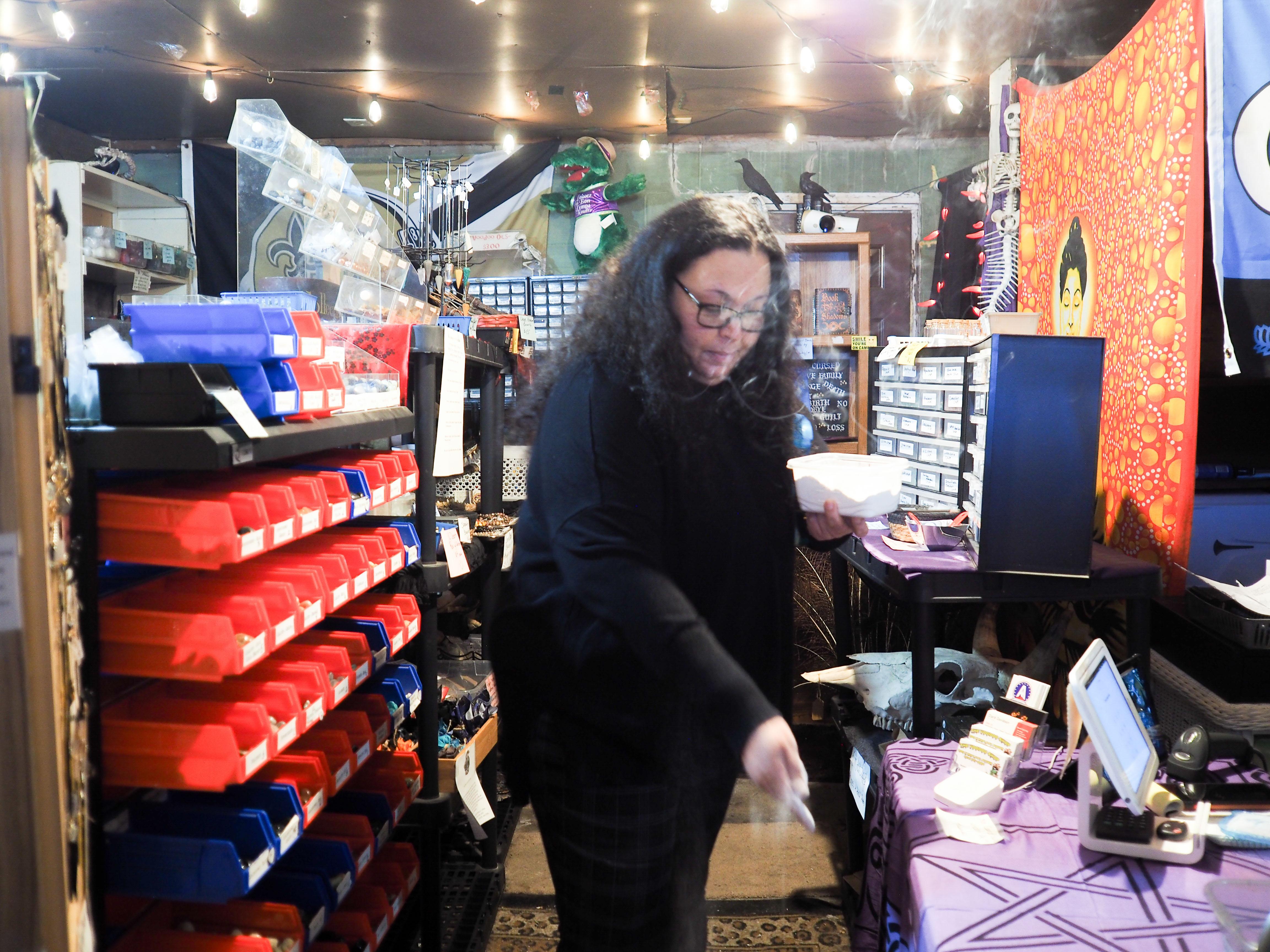
The owner lights two incense sticks, a scent called the Seven African Powers, and sprinkles a mixture of corn starch, peppermint, fenugreek and powdered eggshell about the shop’s nooks and crannies.
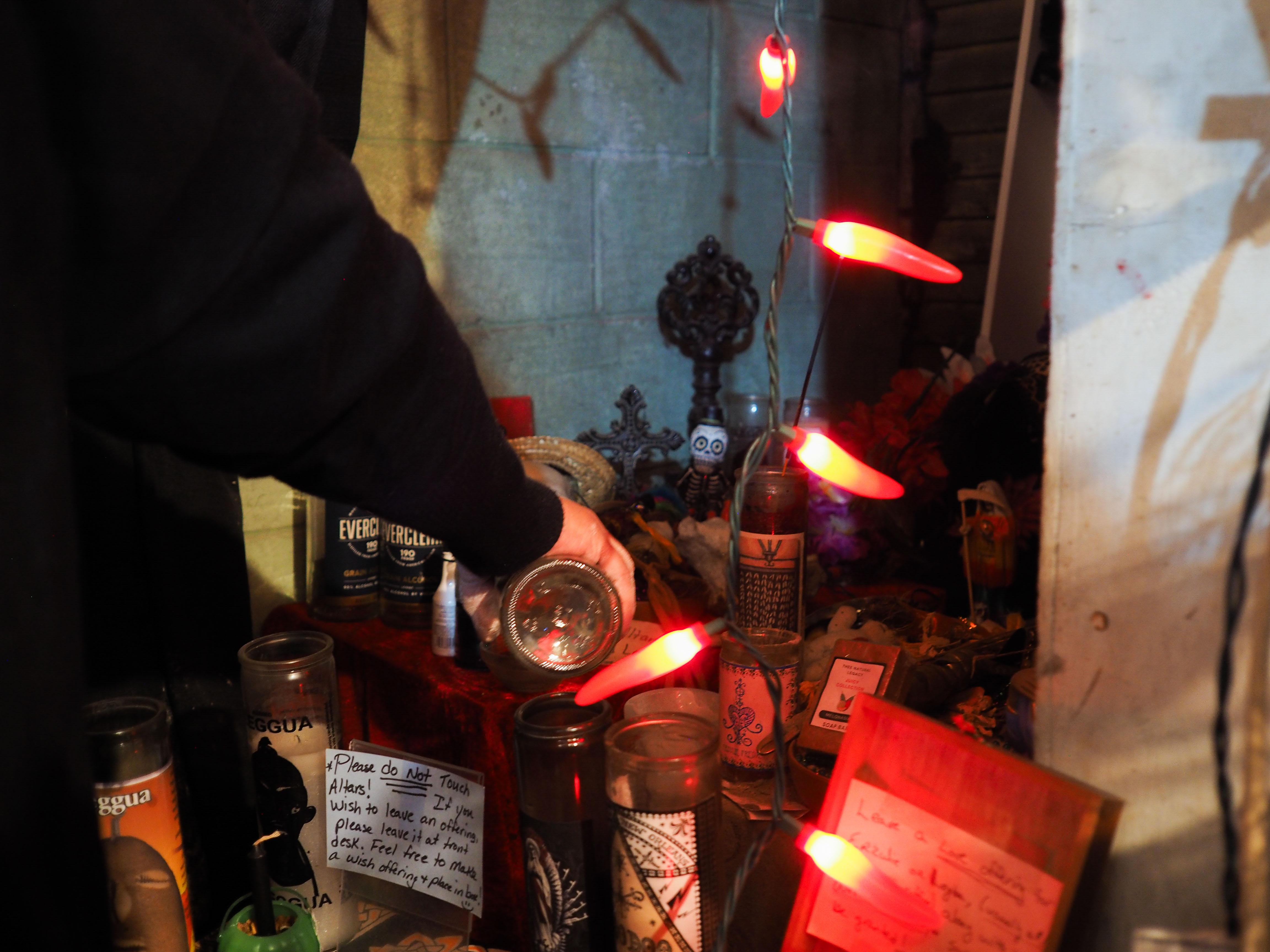
She then tends to the three altars at the back, dedicated to Papa Legba, Erzulie (or Ezili) Freda and Santa Muerte.
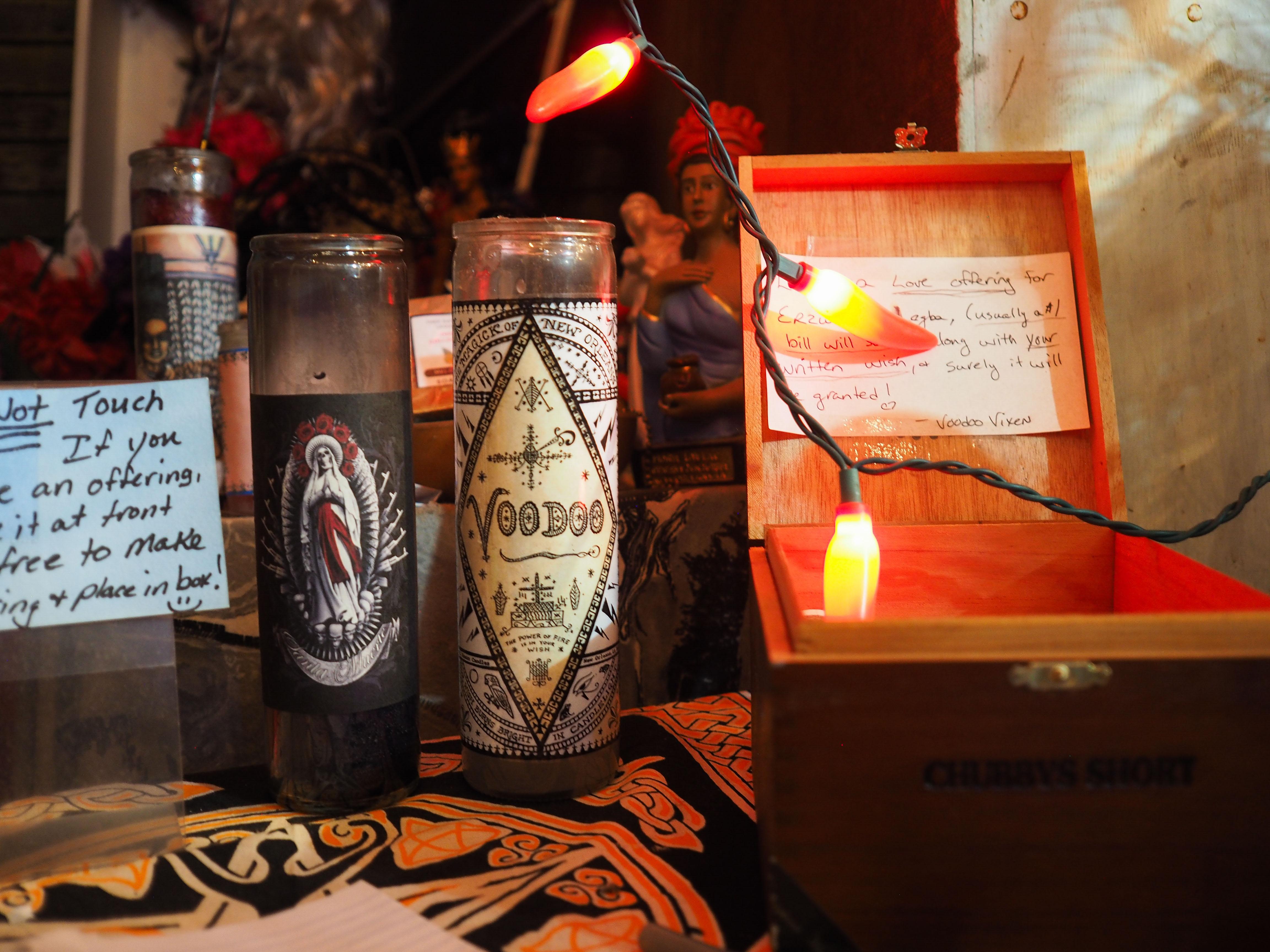
Papa Legba and Erzulie Freda are lwa, or spirits, in Haitian Vodou, a religion influenced by West African traditions. Papa Legba shares connections with the Yoruba deity Eshu and the Orisha Eleguá in Cuban Santería. Santa Muerte is a deity worshipped primarily in Mexico and Central America, though worship of her is growing in the United States.
In the middle of it all, the owner murmurs a quick blessing over the shop, setting her intention of positive energy for the day ahead. Music hums from her iPad on the table, rotating through a playlist with everything from Professor Longhair to Aretha Franklin.
“Bless this space,” she says. “Give me grace to educate.”
Her name is Monice Henson, and she practices ancestral Hoodoo. Though she prefers to go by Mama Mo, a name that more accurately captures her role as someone people seek advice from.
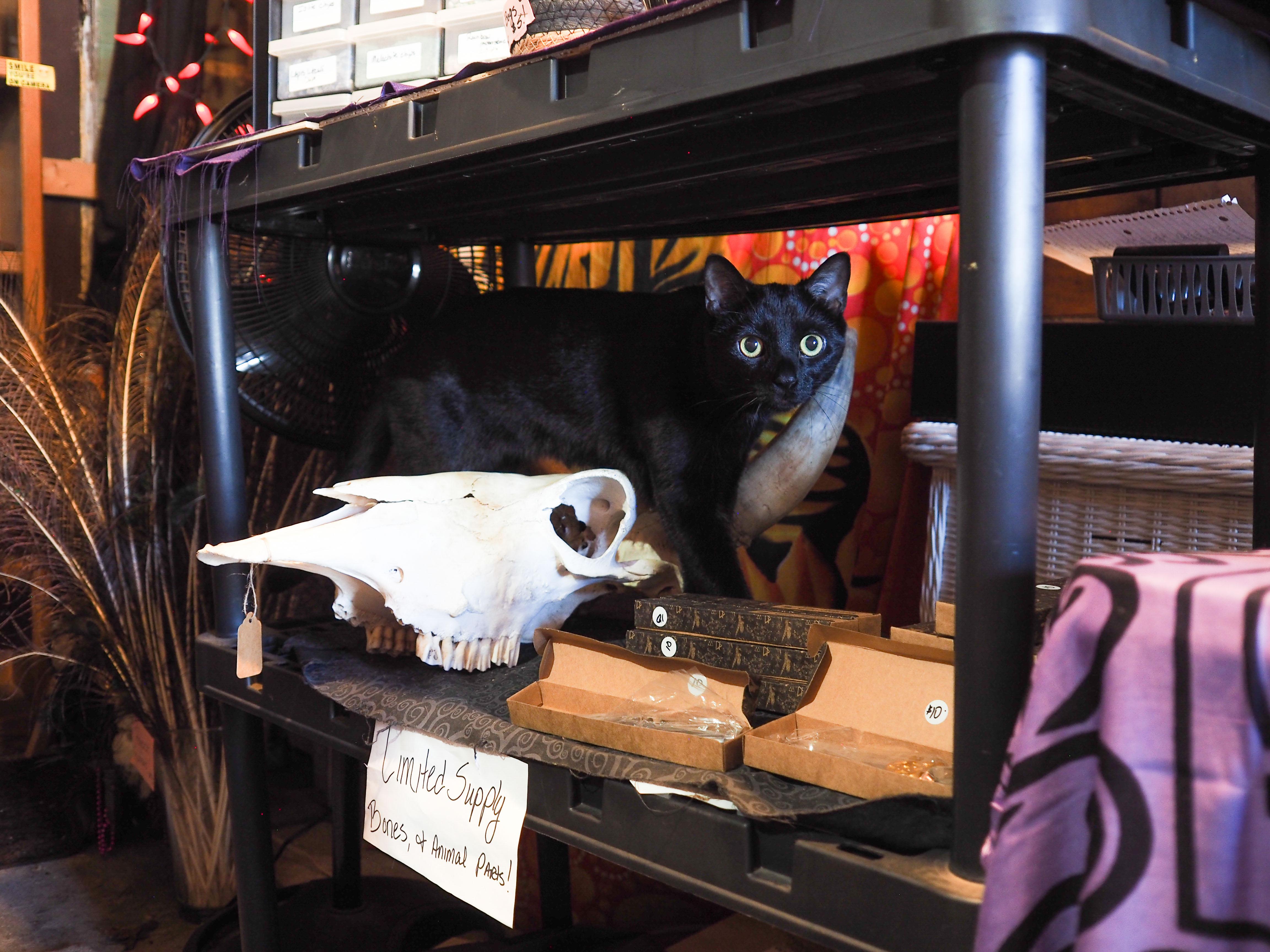
Two black cats sleuth around the shelves. Mama Mo picks up a whisker from the table — a gift from her cat Loki — and deposits it safely into a zip-top bag. As one of the animals that straddle the realm of living and dead in her belief, when cats leave gifts, it’s a sign of good luck. She’ll keep that for later.
•••
In a college town better known for Big Ten sports and limestone, the brightly colored “Voodoo Shop” sign draws attention along a residential street. For its patrons, it marks a sanctuary to find spiritual supplies and, perhaps, a bit of maternal guidance they didn’t know they needed.
“I feel like a lot of people come in with problems or things that they need help with, and I truly believe my mother has a gift at getting that out of people,” Lamonte Henson, Mama Mo’s eldest son, said.
The distinction between Hoodoo and Vodou, Mama Mo said, is Vodou is an “organized religion” still in practice today, originating in Africa but predominantly practiced in Haiti. In the United States, particularly in Louisiana, a similar spiritual and cultural practice developed. Enslaved Africans were prohibited from openly practicing religions from the African diaspora, so they aligned their lwa with Catholic saints, observing rituals under the guise of holy days.
Hoodoo carries a more subjective definition depending on the practitioner. For Mama Mo, Hoodoo is ancestral — a magic passed down from generation to generation. For others, she said, Hoodoo represents a closed ancestral practice exclusive to Black Americans.
“I believe Hoodoo can be multicultural,” she said. “You know, there's Hoodoo in old Italian superstition, there's Hoodoo in African superstition.”
Mama Mo grew up in Bloomington but later moved to New Orleans for a short time, what she deems the “mecca” of Hoodoo and Louisiana Vodou.
Once she returned at the end of 2016, she realized no shops could accommodate her spiritual practice. She panicked.
A couple weeks later, her sister told her about open studio spaces in part of Bloomington’s Artisan Alley, which is now a nonprofit organization. At the time, Mama Mo sold handmade jewelry online while balancing a full-time job as a hairdresser. Eventually, she scored a shelf in a consignment shop in Artisan Alley.
“And then they kept asking for more stuff, more stuff, more stuff,” she said. “So before I knew it, I was working at the consignment shop and also had another full-time job.”
Soon, Mama Mo graduated from a shelf to the smallest studio space available. Eventually, even the biggest space could not accommodate all she wanted to bring to Bloomington. She dreamt of a place where, no matter what patrons practiced, she had that special something for them on her shelves.
“And that became my motto, you know,” she said, “if I don’t have it, I’m gonna get it for you.”
In 2018, Mama Mo opened The Voodoo Shop out of her aunt’s former home. Now, it spans three rooms full of supplies and trinkets for novice or veteran spiritualists.
"I know it was my ancestors talking to me, telling me, there's a lot more people here, there in the same boat you are,” she said. “So you know how the universe kind of works with you, you know, and opens your path."
Inside, one can find crystals, grimoires, tarot decks, spell bags, incense, tea mixes, herbs, deity statues or even animal parts — like crow’s feet or bobcat ribs — on her shelves.
“My whole shop is ghetto fabulous,” she said.
Running it is a full-time job. Nearly every room in the home, save for her children’s bedrooms, has been absorbed into the business. Mama Mo used to live there, too, but now lives with her mother. Her two youngest sons, William and Julian, live at the shop.
Keeping the shop stocked is a constant balancing act. Every few months, she places bulk herb orders and puts overstock on sale. Trial and error shape how she manages inventory. When she over-orders, she runs sales. When she falls behind, she mixes oils and herbs. Without an apprentice, every task falls on her.
In past years, Mama Mo traveled south about three times a year to pick products and visit potential distributors with a route stretching from Atlanta to New Orleans, across Florida and looping back through Tennessee.
And although these trips allow her to select items herself, traveling requires her to temporarily close the shop. Now, without extra help, she can’t afford to shut her doors for a week or two.
“I've got family that depends on my income for this shop, so it's hard, it's, you know, I don't know what to do,” she said.
•••
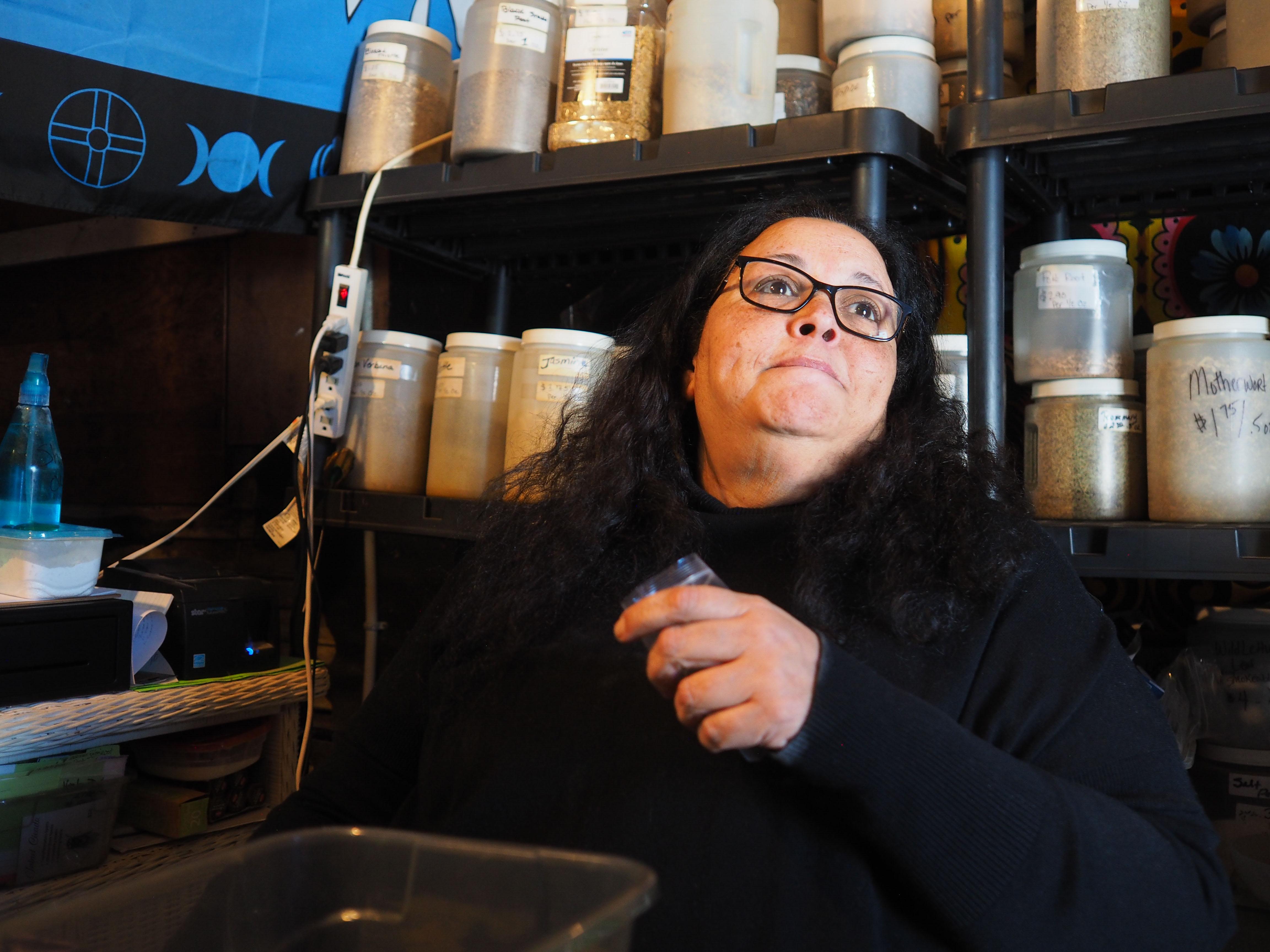
Mama Mo sits at her table at the front of the shop. Behind her are towering shelves filled with tubs of herbs, some of which she retrieves for the tea she’s mixing.
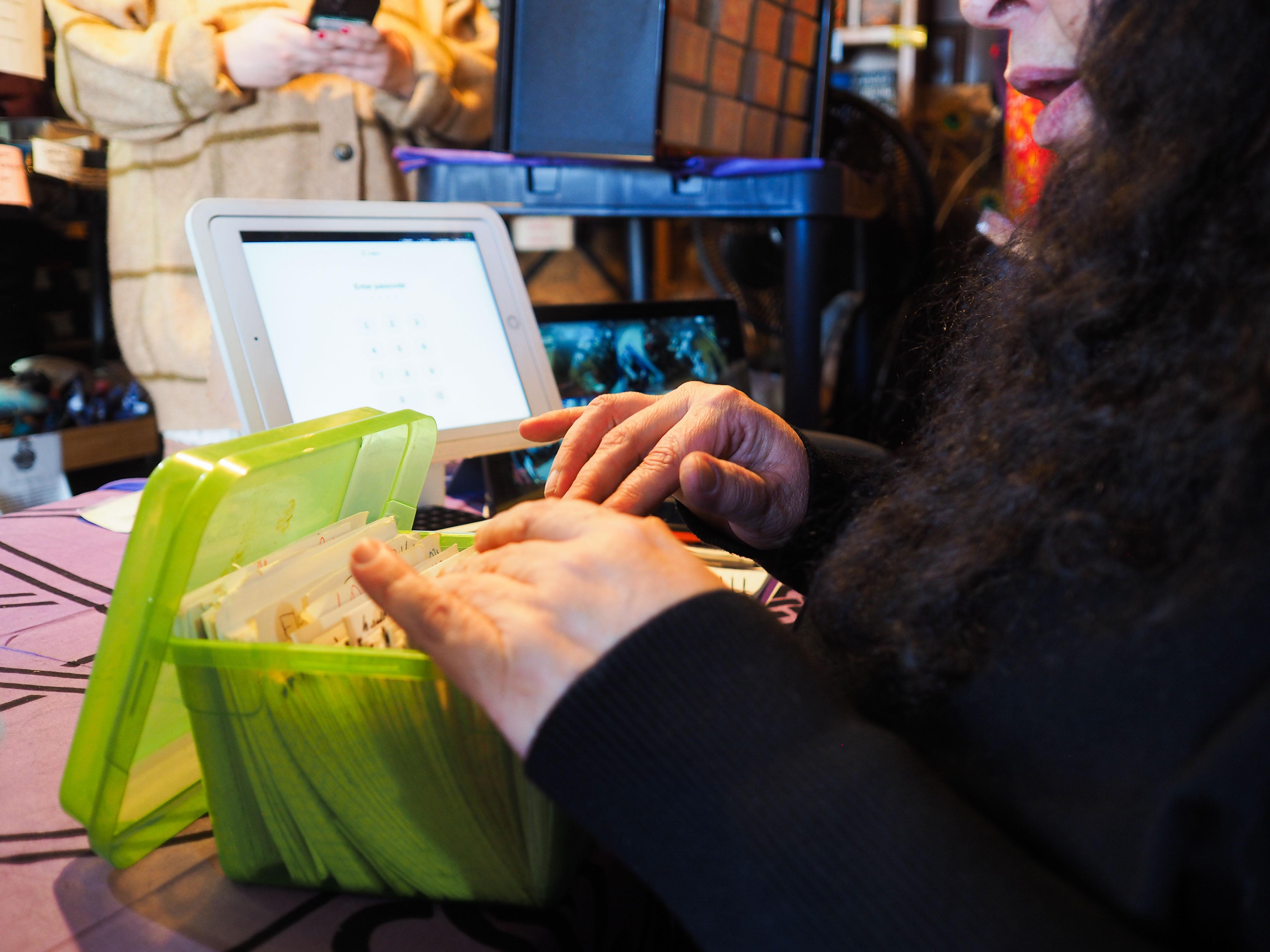
Every oil, tea and herb mixture is made or kept in stock by Mama Mo herself, using recipes left by her grandmother – with a twist of her own. She pulls out a small, green box filled with those recipes, sacred to her practice, and grinds up a mixture in a mortar and pestle.
But before Mama Mo ever mixed a spiritual oil, she watched her grandmother whip up homeopathic medicines for just about any ailment.
“My grandmother always had a salve or a spray or something, you know, to fix whatever was ailing you, and they worked, you know, and people came to her for her products,” Mama Mo said. “And I noticed that at a very young age, so I was envious of that.”
She’s of the belief that everyone has the potential to tap into a spiritual gift. For her grandparents, it was Earth magic — gifts in things like gardening and mixing herbs and other materials from the Earth. She insists her grandfather’s garden was the most lush and beautiful garden she’s seen. Mama Mo said she couldn’t grow a plant to save her life.
She says her gift, like her grandmother’s, is an ability to mix ingredients for an intended result. Sometimes, her recipes are specific to an ailment, such as her “I hate being a girl” tea intended to cure menstrual symptoms.
“My ancestors speak to me,” Mama Mo said. “They tell me what I need to make, when I need to make it.”
She said she hears her ancestors in the back of her head and in her gut. And inside The Voodoo Shop, their presence is amplified.
Despite the sanctity of ancestor work in her practice, Mama Mo said her attempts to trace her lineage bring mixed results.
“My grandmother’s side has Creole blood,” she said. “I don’t have any. I only have oral stories of my lineage from there.”
Those stories tell of a family that came from plantations around Louisiana and later settled in Kentucky before arriving in Indiana.
On Mama Mo’s grandfather’s side, she said her bloodline traces back to Matthew Henson — an explorer said to have discovered the North Pole. However, because her great-grandfather died when her grandfather was a young man, her great-grandmother found someone new.
For many Black Americans like Mama Mo, tracing lineage can prove near impossible. The U.S. slave trade made it very difficult for families to pinpoint exactly where their ancestors came from, as records of those enslaved were unreliably kept or lost to time. As a result, ancestry is often preserved through oral tradition.
“I’m proud of my lineage. I’m proud of my family. I’m proud of what I do,” Mama Mo said.
She said those ancestors sometimes speak through her: a message she’s meant to deliver, an inkling of an item someone needs.
“It becomes part of you, it becomes natural and instinctual,” she said. “It’s not a curse. It’s not something to be scared of.”
For Que Neal, a Hoodoo-Vodou practitioner who has paid Mama Mo some visits over the past few months, the ancestors' presence is palpable in the shop.
"I feel like when you come in this space, you really feel the ancestors, the energy, but you also can come in knowing that you're going to speak with the owner, they're going to give you guidance on what you want,” Neal said. “They're going to give you their best advice and what you should do.”
•••
The shop’s success brings with it challenges. Not everyone treats nontraditional spirituality with deference. Some, Mama Mo said, come in to gawk.
“When you’ve got people just coming in off the B-Line wanting to see what the freak show is, you know, with The Voodoo Shop,” Mama Mo said. “They didn’t have any energy put into it. They didn’t really want to know what it was about.”
IU students, particularly, sometimes don’t take the shop seriously. She said these groups of students, typically groups of girls, come in to ask for “love potions” as they giggle and whisper among themselves.
“'I’m like, ‘again, this is not Harry Potter. You know, all magical rites and rituals require sacrifice, and when you're doing love spells, you know, that's actually black magic,’” she said.
Once they stop at her table, Mama Mo gives them a firm warning about the steep price of black magic — spell works that seek to unduly influence or manipulate others. And in her Hoodoo practice, what one does comes back to them “times 10.”
“A lot of them require blood, you know, different kinds of sacrifices, and they're very personal and very, very ancestrally bound, you know,” Mama Mo said, “So it's powerful shit.”
Despite the occasional gravity of the work, Lamonte said he largely views the Hoodoo his mom practices as a form of healing — one he’s watched her perform just by chatting someone up at the grocery store when she can tell they’re having a bad day.
“I think people have this big misconception of what it is,” Lamonte said. “I think people think of scary curses and voodoo dolls and just all of the negative things that come with it, and they don’t necessarily take the time to learn that that’s not what it is.”
Mama Mo once read tarot cards in a curtained corner of the shop, a service she no longer offers. Other than her needing the space for stock, listening to strangers unpacking heartbreak, uncertainty and sorrow — as well as the large spiritual exchange — took an emotional toll. And without an apprentice to man the front of house, each session began to stretch her too thin.
“It's a big income that I'm losing out on not being able to do that,” she said. “But again, when I did do readings, I'd have to take very frequent breaks, you know, because it takes a lot out of me to do readings.”
When she did offer readings, many requests were about love. As a single mom who raised three boys, Mama Mo said it upsets her even more when women come in to determine whether a boy likes them.
“To see some of these females come in and give all their energy to a douchebag just tears me up, you know,” she said. “And so I'd always try and show them the strength that they had, and some of them just weren't ready to accept that, and it breaks me down.”
•••
As the first patron enters within the first few hours of the shop opening, there’s a chime at the door. Before they peruse her shelves, Mama Mo strikes up a conversation.
“Anything I can help you find, baby doll?” she chirps from her seat.
“Just browsing,” they say.
In a few minutes, that patron opens up to her. Perhaps it's the energy of the shop, or perhaps the ancestors gave them a gentle nudge to speak truth to their troubles. People commonly ask for help on how to rid their homes of negativity. This day was no exception.
“Do you have anything to cleanse my space?”
Mama Mo is immediately invested. She asks whether that person lives in a home or shared space.
“I live in an apartment,” the patron says.
In places like those, Mama Mo says, the influence of different energies in one space can be tricky.
To provide them with the tools they need without getting spiritually involved herself, she points to the array of pre-made spell bags hanging to her left. The customer promptly takes the largest of them, labeled “Complete home cleansing kit with instructions,” off the hook. The bag holds instructions, a prayer, feather, red brick dust, a candle, sage, black tourmaline, white quartz, iron nails and holy water.
And with a few taps on her iPad and the swipe of a debit card, Mama Mo and her ancestors claim their first sale of the day.
Like what you're reading?
Support independent, award-winning student journalism.
Donate.